
EAEU EAC Mark and China CCC: The Certification Languages of Two Major Markets
Two giant markets, two different documentation languages.
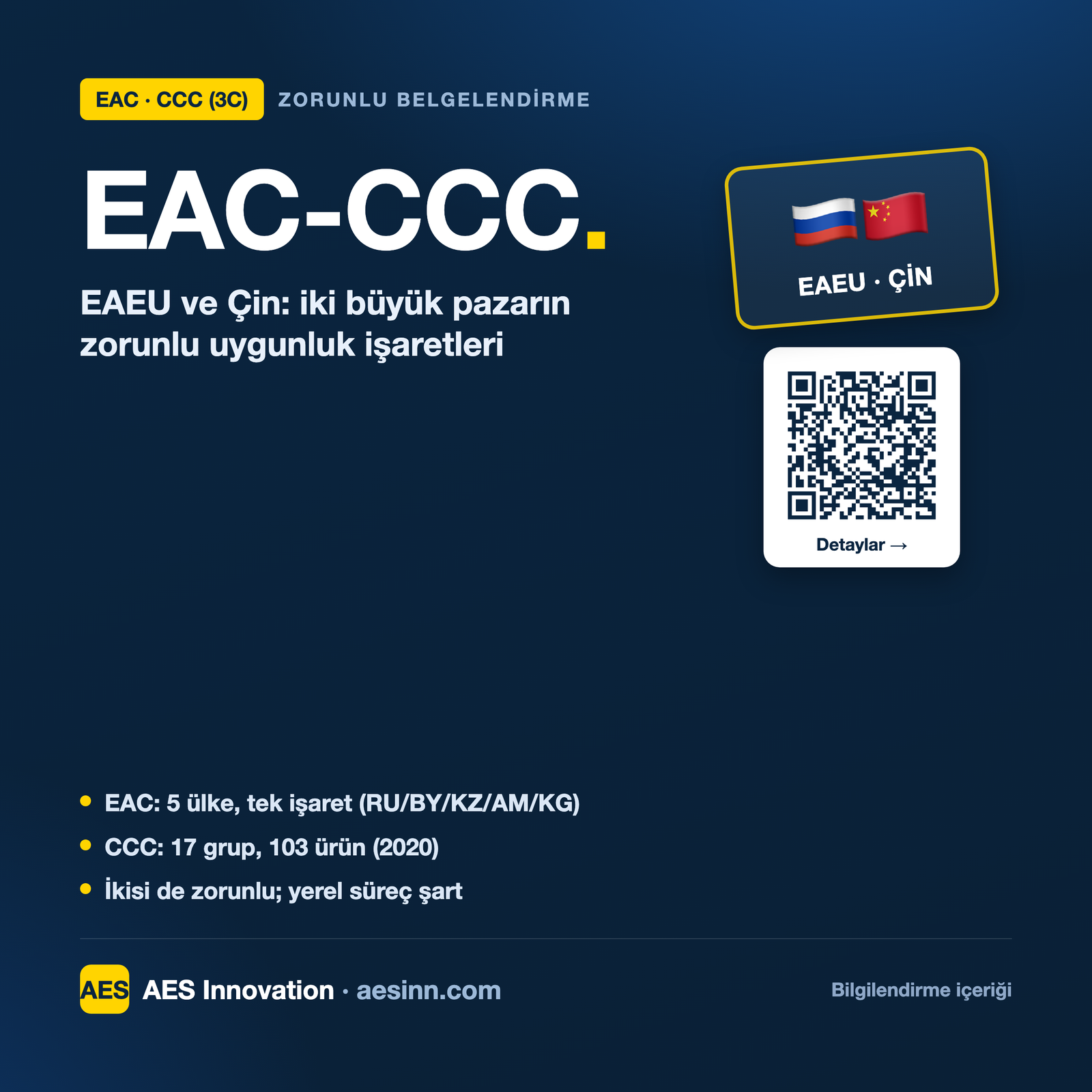
The Eurasian Economic Union (EAEU), bringing together five countries led by Russia, and China, one of the world's largest production and consumption markets, are two giant geographical regions that Turkish exporters frequently turn to. In both countries, market entry for many electrical products and machinery is not possible without obtaining a mandatory conformity mark: the EAC mark in the EAEU and the CCC (commonly known as '3C') mark in China.
At first glance, these markings appear similar to the European CE mark. However, their operational principles differ. While CE allows manufacturers to declare conformity based on their own technical documentation for many product groups, both the EAEU and Chinese systems rely heavily on domestic processes: a local representative/applicant, testing in designated laboratories, and in most cases, factory inspections. Therefore, treating the two systems as 'a copy of CE' often leads to wasted time and money.
EAC designation and EAEU technical regulation system
The Eurasian Economic Union was established on January 1, 2015, and today includes Russia, Belarus, Kazakhstan, Armenia, and Kyrgyzstan. Its predecessor, the Customs Union, had a common Customs Code that entered into force on July 1, 2010. This integration aimed to unify the Soviet legacy GOST standards and country-specific systems (GOST R in Russia, STB in Belarus, GOST K in Kazakhstan) under a single, binding technical regulation.
The EAC (Eurasian Conformity) mark, the conformity symbol of this framework, was defined by Commission Resolution No. 711 of 15 July 2011 and replaced the former GOST R conformity mark. A product bearing the EAC mark can circulate freely in all five member states. Today, more than 50 technical regulations have been adopted in the EAEU; those adopted before the Union are numbered 'TR CU 0XX/2011–2014', and those adopted afterwards are numbered 'TR EAEU 0XX/2016' and so on.
The most common technical regulations for electrical products and machinery are as follows:
- TR CU 004/2011 — Safety of low-voltage equipment (equivalent to the EU Low Voltage Directive)
- TR CU 020/2011 — Electromagnetic compatibility (EMC)
- TR CU 010/2011 — Machine and equipment safety
- TR EAEU 037/2016 — Restriction of hazardous substances in electrical and electronic equipment (largely compliant with EU RoHS Directive 2011/65/EU; 6 substances: lead, mercury, cadmium, hexavalent chromium, PBB and PBDE)
China CCC and mandatory product catalog
China's compulsory certification system, CCC (China Compulsory Certification), is popularly known as '3C' due to the three Cs in the designation. The system was implemented on May 1, 2002, became fully mandatory from August 1, 2003, and combined previously separate domestic (CCEE/'Great Wall') and imported (CCIB) safety markings under a single designation.
The system is administered nationally by CNCA (Certification and Accreditation Administration); since 2018, CNCA has been under the umbrella of the Market Regulation Administration (SAMR). The main designated body processing applications is CQC (China Quality Certification Centre), but there are other designated bodies depending on the sector. All assessments are based on China's GB (Guobiao) national standards.
An important point: CCC is only mandatory for products listed in the official catalog. Following SAMR's revision in April 2020, the catalog was reorganized to include 17 product groups and 103 product items. The main groups covered are:
- Cables and wires; circuit switches, protective and connecting devices.
- Low-voltage devices; small power motors; electric hand tools; welding machines.
- Electrical appliances for household and similar use; lighting fixtures.
- Motor vehicles and safety accessories; agricultural machinery.
- Fire products; safety/protection products; building materials; children's products; household gas appliances.
Who will be affected?
The scope of application is determined by the target market and product category. On the EAEU side, manufacturers exporting electrical equipment, electronics, machinery, or components of these products to Russia and the Commonwealth of Independent States are directly covered by the EAC. On the Chinese side, only those exporting products listed in the CCC catalog are subject to this requirement; CCC is not required for products not listed in the catalog, but it is essential to confirm this with the current catalog rather than assuming it is not necessary.
In practice, the most affected Turkish producer profiles are as follows:
- Manufacturers of electrical household appliances, lighting fixtures and electronic devices.
- Manufacturers of machinery, control panels, drives/motors, and low-voltage equipment.
- Manufacturers of cables, connectors, and electrical protection/fastener components.
- Automotive suppliers and safety accessory manufacturers.
Basic obligations and documentation logic of the two systems
Both systems are based on the 'test, prove, mark' chain; the differences lie in the details and who does the certifying. On the EAEU side, there are three main paths depending on the product category: a Certificate of Conformity issued by an accredited body (high-risk products), a Declaration of Conformity prepared under the manufacturer's responsibility but registered in the official register, and State Registration for some products. Even the declaration path requires proof of test, and the applicant is expected to be a legal entity established in the EAEU; therefore, foreign manufacturers usually proceed through a local authorized representative or importer.
In China, the classic CCC approach is more standardized and less reliant on pure self-declaration: type testing at a laboratory designated by the CNCA, followed by on-site factory inspection and post-certification annual surveillance audits. The certificate is issued by a designated organization such as the CQC. Although a self-declaration pathway that doesn't require a factory inspection has been available for some low-risk categories since 2018, this pathway is limited and requires testing at a recognized laboratory and registration of the declaration with the CNCA.
We can roughly summarize the documentation logic of the two systems as follows:
- Who issues the document: In the EAC, accredited bodies in member countries (certificate) or the manufacturer (declaration); in the CCC, only designated bodies (CQC, etc.)
- Local arm: In the EAC, the applicant/representative established in the EAEU; in the CCC, the designated entity in China and usually an applicant contact.
- Testing: in both cases, a recognized/designated laboratory; free declaration based entirely on one's own file, as in CE, is not common.
- Factory inspection: CCC is the classic rule on the road; EAC is frequent in mass production certifications.
Important dates
The following dates summarize the milestones of the two systems and the thresholds that manufacturers should consider in their planning. Because regulatory texts are revised from time to time, the current version applicable to the product should always be verified from the official source.
- July 1, 2010 — The Customs Union's common Customs Code entered into force.
- 15 July 2011 — The EAC designation was defined by Commission Resolution 711.
- January 1, 2015 — The Eurasian Economic Union (EAEU) was officially established.
- 1 March 2018 — TR EAEU 037/2016 (EAEU RoHS) entered into force; the transition period ended on 1 March 2020, making it fully mandatory.
- May 1, 2002 / August 1, 2003 — China implemented and made CCC fully mandatory.
- April 28, 2020 — SAMR reorganized its CCC catalog into 17 groups / 103 products.
What does this mean for Turkish manufacturers?
Both markets require preparation that goes beyond a simple "prepare and ship" approach. Realistic budget and schedule planning, establishing a local representative/application system, having tests conducted in designated or accredited laboratories, and being prepared for factory audits when necessary are fundamental. Preparing the technical file and labels in the target market's language and expected format is also a root cause of many delays. In short, conformity is not a one-time document; it is a sustainable compliance process.
At this point, it is necessary to clearly define AES's role. As a TÜRKAK-accredited Type A electrical inspection body, AES provides expert support in the field of electrical safety of machinery and electrical equipment (e.g., EN 60204-1 and CMSE competency framework). Since all machinery, low voltage, and EMC-focused regulations under EAC and CCC are fundamentally based on electrical safety, identifying and resolving electrical safety deficiencies in advance at the production site provides a solid basis for evidence in subsequent conformity assessments.
Important note: AES is an electrical inspection organization; it does not issue EAC or CCC certificates or perform product certification. EAC and CCC certificates are issued by designated or accredited organizations in the relevant market. AES's contribution is limited to strengthening the electrical safety aspect with expert insight and providing objective information before these certifications are obtained. Properly structured preparation reduces both surprises and the costs of retesting/inspection.
Frequently Asked Questions
Are the EAC mark and the CE mark the same thing?
No. Both are mandatory conformity marks and are based on similar technical regulations, but the EAC is only valid for the EAEU (Russia, Belarus, Kazakhstan, Armenia, Kyrgyzstan). Furthermore, with the EAC, the applicant is expected to be established in the EAEU and the tests must be recognized by regional authorities; a declaration based solely on your own technical file, as with CE, is insufficient for most products.
Does China require a CCC certificate for every product?
No. CCC is only mandatory for products listed in the official catalog. As per SAMR's April 2020 amendment, the catalog covers 17 groups and 103 product items. You need to confirm whether your product is covered by the current catalog; CCC is not required for products outside the scope.
Can I obtain the CCC certificate by submitting it myself?
No, not the classic CCC route. The process requires type testing in a designated laboratory, factory inspection, and annual surveillance; the certificate is issued by a designated organization such as CQC. While a self-declaration pathway that doesn't require factory inspection has existed for some low-risk categories since 2018, this is exceptional and requires testing to be carried out in a recognized laboratory and registered with CNCA.
Which EAEU regulations stand out in the export of electrical machinery?
The most common are TR CU 004/2011 (low voltage safety), TR CU 020/2011 (EMC), TR CU 010/2011 (machinery and equipment safety) and TR EAEU 037/2016 (EAEU RoHS). A product may be subject to more than one regulation simultaneously, depending on its application.
Can AES provide us with EAC or CCC certification?
No. AES is a TÜRKAK-accredited Type A electrical inspection body and does not perform product certification; EAC and CCC certificates are issued by designated/accredited bodies in the relevant market. AES's contribution is limited to expertly assessing the electrical safety of machinery within the framework of standards such as EN 60204-1 and strengthening pre-certification preparation.
This content is for informational purposes only and does not constitute a commitment to providing services or advice. Please contact us with any questions.