
EU Deforestation Regulation (EUDR): Comprehensive Guide for Turkish Exporting Producers
What is EUDR and why is it important?
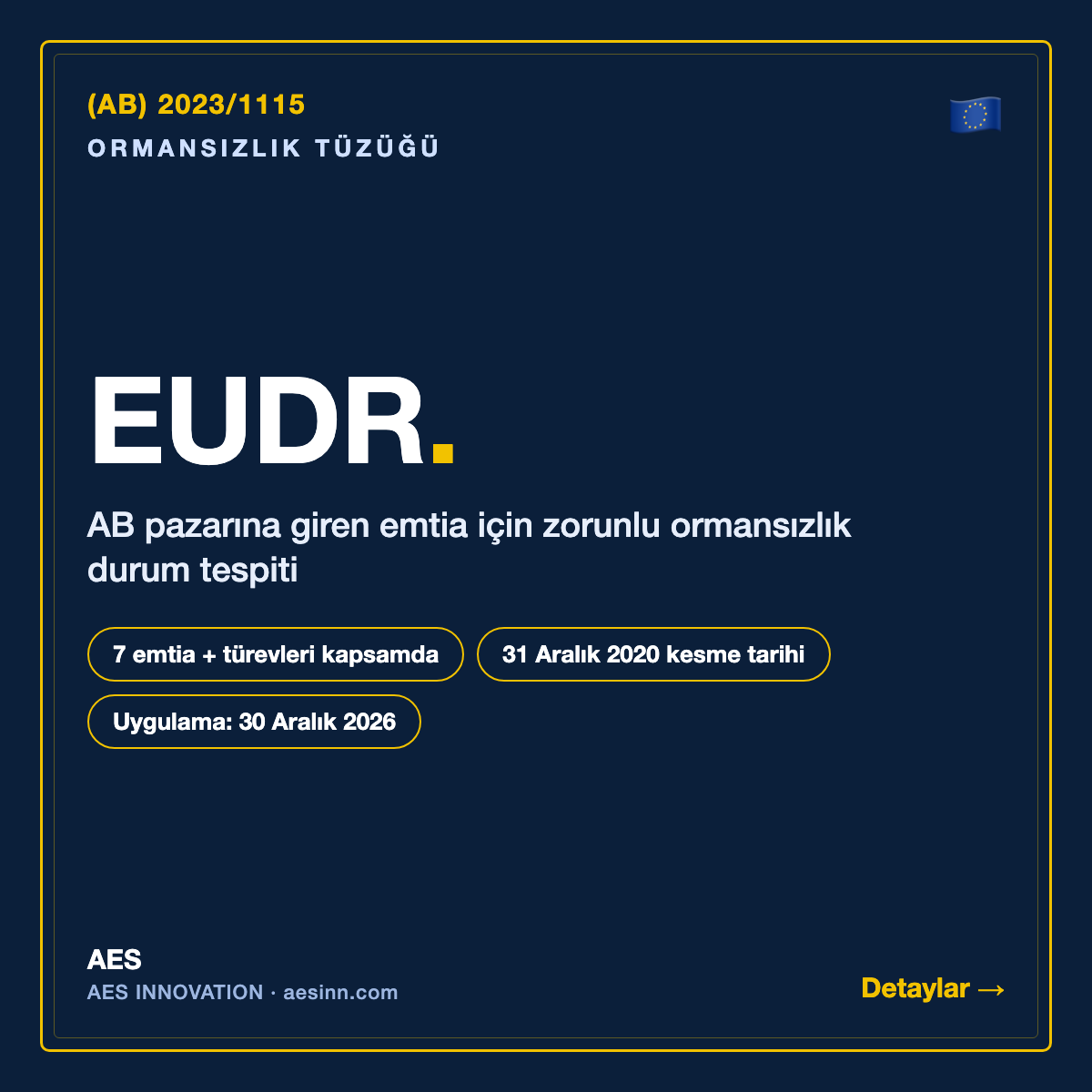
The EU Deforestation Regulation – officially Regulation (EU) 2023/1115 (EUDR) – is the European Union’s environmental legislation aimed at halting the contribution of timber consumption to global deforestation. The Regulation is dated 31 May 2023, was published in the Official Journal of the EU on 9 June 2023, and entered into force on the same date. It replaces the previous EU Timber Regulation (995/2010) and expands its scope to include a much wider range of commodities than just timber.
The basic logic of the regulation is simple: in order for a product covered by the regulation to be placed on the EU market or exported from the EU, it must be proven that the raw materials for that product were produced on land that has not been deforested or degraded since 31 December 2020. This is not just a labeling declaration; it is a traceable and verifiable 'due diligence' obligation based on geographical coordinates.
The critical aspect of EUDR for Turkish producers is that the obligation applies to every product entering the EU market, regardless of its origin. This means that a Turkish company exporting coffee, leather, furniture, paper, or chocolate to the EU is also part of this chain and generally has to provide information and geographical data all the way back to the supply chain.
Who is affected? Covered commodities and products.
The EUDR covers seven main commodities and numerous derivative products derived from them. It includes companies that process raw materials directly, as well as those that supply composite products containing these commodities to the EU. Whether a product falls within the scope is determined according to the customs tariff codes (HS/CN) listed in the annex to the Regulation; therefore, checking your product's tariff position is the first step.
- The seven commodities covered are: cattle, cocoa, coffee, palm oil, rubber, soy, and wood.
- Wood derivatives: furniture, paper and pulp, wooden packaging, printing products.
- Leather and leather products (of bovine origin).
- Cocoa derivatives: chocolate and food products containing cocoa.
- Rubber derivatives: tires and rubber products.
- Palm oil and soy derivatives: used in food, animal feed, and some cosmetic/oleochemical products.
Key responsibilities: how does due diligence work?
At the heart of the EUDR is the 'due diligence' process. Operators (and under certain conditions traders) who introduce the product covered to the EU market for the first time must fulfill a three-stage obligation cycle: information gathering, risk assessment, and, where necessary, risk mitigation. Once the process is complete, a 'due diligence statement' is submitted via the EU's central information system.
The distinguishing element of this obligation is the collection of the geographic coordinates (geolocation) of the production area. That is, the latitude and longitude of the parcel from which the raw material originates must be recorded, and it must be demonstrated that this parcel has not been deforested after December 31, 2020, and that the production complies with the relevant legislation of the producing country (legal production).
- Information gathering: product description, quantity, supplier information, and geographical coordinates of the production site.
- Evidence of deforestation: demonstrating that the raw material did not cause deforestation/forest degradation after December 31, 2020.
- Legal production declaration: proof that production complies with the relevant laws of the producing country (land use, environment, labor rights, taxes, etc.).
- Risk assessment and mitigation: reducing the remaining risk to a negligible level.
- Due diligence statement: Registration and submission of the statement to the EU information system (TRACES).
Important dates (updated calendar after postponement)
The implementation dates for the EUDR have been postponed multiple times. Although the Regulation entered into force in 2023, the dates on which the essential obligations would actually begin to be applied have been changed. The most recent postponement was made with the amending Regulation (EU) 2025/2650, published in December 2025, which introduced a general one-year extension.
The following dates reflect the calendar valid as of August 2026, when this article was prepared. The practical implication for businesses is that the implementation time is approaching, and the time remaining for preparation is relatively short.
- June 9, 2023: Regulation (EU) 2023/1115 was published in the Official Journal of the EU; it entered into force shortly thereafter.
- December 31, 2020: the reference (cutting) date for deforestation — products grown on land deforested after this date are excluded.
- December 30, 2026: The effective date for essential obligations for large and medium-sized operators and traders of all sizes.
- June 30, 2027: Implementation date for micro and small-scale businesses and individuals.
- Reference change: Regulation (EU) 2025/2650 (December 2025) set this updated timetable.
What does this mean for Turkish manufacturers?
Turkey exports significant volumes of furniture, paper/cardboard, leather and leather products, and food products including cocoa/chocolate and coffee to the EU. Many of these product groups fall directly under the scope of the EUDR. In practice, your EU buyer (importer/operator) will request the necessary data from you to complete the due diligence; therefore, although the legal obligation lies with the EU, the responsibility for providing the data effectively extends down the supply chain to the Turkish producer.
The most challenging aspect is often geographical coordinates and traceability. For example, a leather exporter may need to provide the coordinates of the land where the cattle were raised, and legal proof of production, while a paper exporter may need to provide the coordinates of the forest plot from which the cellulose originated. Supply chains with incomplete or untraceable data can lead to EU buyers rejecting the product or turning to an alternative supplier.
Therefore, it is correct to view the EUDR not merely as 'EU bureaucracy', but as a matter of market access and competition. Manufacturers who make their supply chains transparent and documented today will be the preferred suppliers for EU buyers when the implementation dates arrive.
Preparation steps: where to start?
Compliance with the EUDR is not a one-time document process, but a continuous data and traceability system to be established throughout the supply chain. The following steps will help you build a solid foundation before the implementation deadlines. This information is general; the official Regulation text and European Commission guidance should be used as a basis for your product's scope and specific obligations.
- Scope determination: Compare the customs tariff (HS/CN) codes of your products with the annex to the Regulation; clarify which of your products are covered.
- Supply chain map: Create a traceable supplier map of raw materials, back to their source (land/parcel level).
- Geographic data collection: Establish a method to collect the geographic coordinates (geolocation) of production sites; agree on data sharing with your suppliers.
- Legal production documents: Gather documents demonstrating compliance with the relevant legislation of the country of origin (land use permits, environmental/labor rights compliance, etc.).
- Communicate with your EU receiver: find out early on exactly what data and format your receiver (operator) requires for due diligence.
- Internal systems and records: Establish a filing/record-keeping system to keep data organized; designate a responsible team or individual.
- Follow official sources: Regularly check EUR-Lex and Commission guidelines as there may be changes to the regulations and implementation dates.
Frequently Asked Questions
Does the EUDR only bind EU companies? As a Turkish manufacturer, do I have any obligations?
The legal responsibility lies with the operator or trader who brings the product to the EU market; this is usually your importer in the EU. However, your EU buyer will request the necessary information, geographical coordinates, and legal proof of production from you in order to complete the due diligence. Therefore, in practice, the responsibility for providing data extends all the way down the supply chain to the Turkish manufacturer.
Which of my products are covered? How do I know?
The scope includes cattle, cocoa, coffee, palm oil, rubber, soy, and wood, and their derivatives. Precise determination is made according to the customs tariff (HS/CN) codes listed in the annex to the Regulation. The first step is to compare the tariff positions of your products against this list; composite products such as furniture, paper, leather, and chocolate are also frequently included.
When does the program start? Has there been any delay?
Yes, the dates have been postponed multiple times. As of August 2026, the current calendar is: 30 December 2026 for large and medium-sized operators and traders; and 30 June 2027 for micro and small businesses and individuals. This current calendar is established by amendment (EU) 2025/2650, published in December 2025.
Are geographic coordinates (geolocation) mandatory? Why are they required?
Yes. A key element of due diligence is collecting the geographic coordinates of the land where the raw material is produced. These coordinates allow for verification, using satellite and map data, that the relevant plot has not been deforested since December 31, 2020. Supply chains where coordinates cannot be obtained pose a high risk in terms of compliance.
Should I start preparing now, or should I wait until 2026?
It is strongly recommended to start now. Making the supply chain traceable down to the field level, establishing a coordinate collection system, and compiling legal production documentation takes time. Producers who complete compliance early will be the preferred suppliers for EU buyers and will be able to operate without interruption when the implementation deadlines arrive.
This content is for informational purposes only and does not constitute legal opinion or compliance assessment. The current official legislation text (EUR-Lex) should be used for precise requirements.