

ESPR and Digital Product Passport (DPP): A Comprehensive Guide for Exporting Manufacturers
ESPR: Europe's new sustainable product framework.
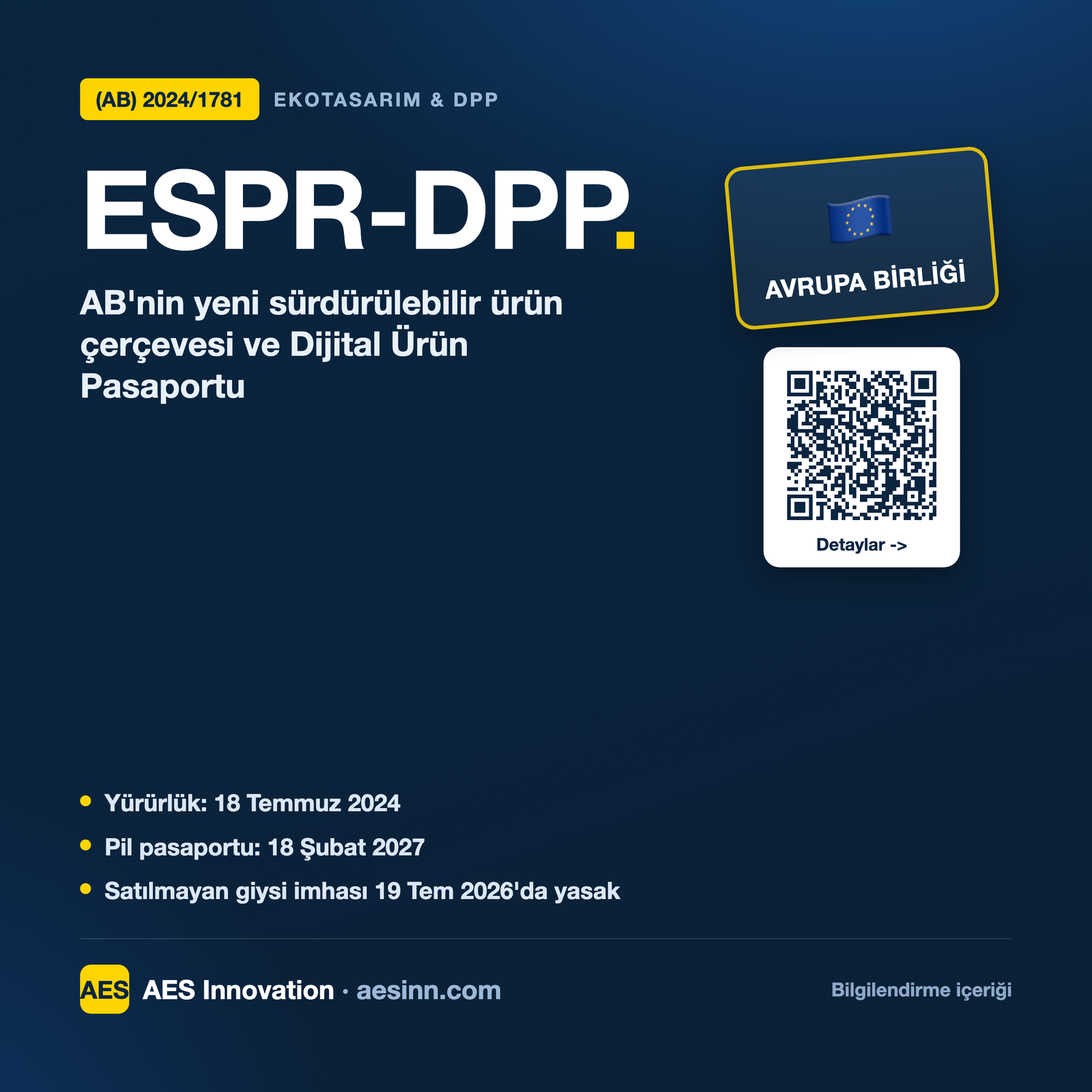
The European Union has established a comprehensive framework to reduce the environmental footprint of products throughout their entire lifecycle, from production to waste. This framework is called the Ecodesign for Sustainable Products Regulation (ESPR). Its official name is Regulation (EU) 2024/1781; it was adopted on 13 June 2024, published in the Official Journal of the EU on 28 June 2024, and entered into force 20 days later, on 18 July 2024.
The ESPR repeals the old Ecodesign Directive (2009/125/EC) of 2009. The biggest change here is the scope: while the old directive only regulated energy-related products (such as household appliances, lighting, and motors), the ESPR becomes applicable to almost all physical products, with a few exceptions such as food, feed, and medicinal products for humans.
ESPR is a 'framework regulation'. This means it doesn't impose specific requirements on every product; instead, it is implemented gradually through secondary regulations called 'delegated acts' issued by the European Commission for each product group. Therefore, the impact of ESPR will not be felt immediately, but rather product group by product, over the years.
Key responsibilities: what is expected from ecodesign?
ESPR introduces 'ecodesign performance requirements' to be defined separately for each product group. The aim is to make products more durable, consume fewer resources, and be compatible with the circular economy from the design stage onwards. One or more of the following headings may be regulated in the delegated act of a product group:
ESPR regulates not only the physical characteristics of a product but also the information to be provided about it. The most concrete tool for this information obligation is the Digital Product Passport (discussed in detail in the next section). The regulation also places limits on the destruction of unsold consumer goods: for large companies, the destruction of unsold clothing, clothing accessories, and footwear is prohibited as of July 19, 2026; for medium-sized companies, this prohibition begins in 2030.
In addition, ESPR lays the groundwork for criteria for green public procurement and 'horizontal' measures that could be applicable across the sector (e.g., repairability score and recyclability of electrical and electronic equipment).
- Durability, reliability, and lifespan.
- Repairability, upgradeability, maintenance and remanufacturing capabilities.
- Reusability and recyclability, along with recycled material content.
- Energy and resource efficiency
- Presence and traceability of substances of concern.
- Carbon and environmental footprint, and expected amount of waste.
What is a Digital Product Passport (DPP)?
A Digital Product Passport (DPP) is a record that brings together environmental, material, and technical data of a product in a structured and digitally accessible format. In practice, the product carries a data carrier (usually a QR code or RFID tag); this carrier is linked to a unique identifier specific to the product and to a registry maintained at the EU level.
The goal of a DPP (Digital Product Purpose) is to make accurate product information available to the entire value chain – consumers, distributors, repairers, recyclers, and market surveillance authorities. Each stakeholder is informed about which information is visible and at what level (while protecting trade secrets). The exact data included in a DPP is not uniform; it is determined by the delegated act of the relevant product group.
DPP will not start simultaneously for all products, but will be implemented gradually on a product group basis. An important distinction: in practice, the first mandatory digital passport is the 'battery passport', which comes under the EU Battery Regulation (Regulation (EU) 2023/1542), a separate regulation, not under ESPR itself. Within the framework of ESPR, textiles stand out as one of the first product groups to be included.
Who will be affected?
ESPR (Exclusive Economic Zone) looks at whether a product is placed on the EU market, not where it is manufactured. Therefore, anyone who places a product on the market or offers a service in the EU – including manufacturers within the EU, as well as Turkish manufacturers exporting to the EU and their EU importers – is covered. In short, saying 'I don't manufacture in the EU' does not mean I am exempt from the obligation.
The priority products were determined by the Commission's 2025-2030 Work Plan, adopted on 16 April 2025. The first wave of priority product groups are as follows:
In addition to this list, the plan also includes sector-wide horizontal measures (repairability score and recyclability of electrical and electronic equipment). Batteries, however, are regulated separately under their own regulation (EU) 2023/1542, outside of the ESPR.
- Steel and aluminum
- Textiles (especially ready-made clothing)
- Furniture
- Tires
- Mattresses
- A range of energy-related products
Important dates
When following the ESPR and DPP timetables, it is necessary to distinguish between the 'entry date of the framework regulation' and the 'implementation date of the delegated acts specific to each product group'. Some of the following dates are official and definitive, while others are indicative dates specified in the Commission's plan and may change as the process progresses:
- June 13, 2024 – Adoption of ESPR (Regulation (EU) 2024/1781)
- 28 June 2024 – Publication in the Official Journal of the EU
- July 18, 2024 – ESPR enters into force.
- April 16, 2025 – Adoption of the 2025-2030 Ecodesign Work Plan (COM(2025) 187)
- July 19, 2026 – Ban on the destruction of unsold clothing, accessories, and footwear by large companies comes into effect.
- February 18, 2027 – Battery passport becomes mandatory (EU Battery Regulation (EU) 2023/1542; EV, industrial >2 kWh and light transport vehicle batteries)
- 2027 (indicator) – Expected adoption of the Textile Delegated Act; implementation of related DPP and ecodesign requirements will be delayed to later years.
What does this mean for Turkish manufacturers?
The European Union is the largest export market for Turkish industry, and textiles and apparel, one of the first areas targeted by the ESPR, is one of Türkiye's strongest export sectors. Therefore, for many Turkish manufacturers, the ESPR and DPP are not 'distant European legislation,' but a concrete agenda that will become a prerequisite for sales to the EU in the next few years. Starting preparations early provides an advantage, avoiding rushing when the delegated acts become clearer.
Practical preparation is largely data-driven. When the DPP (Direct-to-Product) requirement comes into effect, companies will be expected to collect and reliably present data on material composition, recycled content percentage, repairability and durability information, carbon and environmental footprint on a product-by-product basis. Establishing a traceability and regular technical documentation infrastructure throughout the supply chain are the first steps that need to be taken.
In the case of electrical and electronic products, ecodesign requirements are intertwined with energy efficiency, safe design, and technical documentation. AES, a TÜRKAK-accredited Type A electrical inspection body, is a valuable resource that can contribute to manufacturers' understanding of the electrical and technical aspects of these regulations, thanks to its expertise in the electrical safety of machinery and equipment (e.g., within the framework of EN 60204-1). This text is for informational purposes only; product certification or declaration of conformity processes under ESPR/DPP are carried out by the relevant competent authorities.
Frequently Asked Questions
What is the main difference between ESPR and the old Ecodesign Directive?
The old directive (2009/125/EC) only covered energy-related products. The ESPR (Regulation (EU) 2024/1781) expands this scope to almost all physical products, with a few exceptions (food, feed, medicinal products for humanity, etc.), and introduces new tools such as the Digital Product Passport and limits on the disposal of unsold products.
Will the Digital Product Passport be mandatory for all products simultaneously?
No. DPPs are implemented gradually, on a product group basis, through delegated acts issued by the Commission. In practice, the first mandatory passport is the battery passport under the EU Battery Regulation (February 18, 2027), which is a separate regulation. Under ESPR, textiles are one of the first groups.
Would a Turkish company that doesn't manufacture in the EU, but only exports, be affected by ESPR?
Yes. ESPR looks at whether a product is intended for the EU market, not where it is manufactured. Turkish manufacturers selling products to the EU, and their importers in the EU, are also subject to this obligation.
What information will be entered into the Digital Product Passport?
Content varies by product group and is determined by the relevant delegated act. Typically, data includes material composition, recycled ingredients, reparability and durability, environmental footprint, and substances of concern. The information is accessed via a data carrier such as a QR code or RFID on the product.
Who is covered by the ban on destroying unsold products?
For large companies, the destruction of unsold clothing, clothing accessories, and footwear will be prohibited from July 19, 2026. For medium-sized companies, this obligation begins in 2030; very small and small businesses are exempt from this specific ban.
This content is for informational purposes only and does not constitute a commitment to providing services or advice. Please contact us with any questions.