

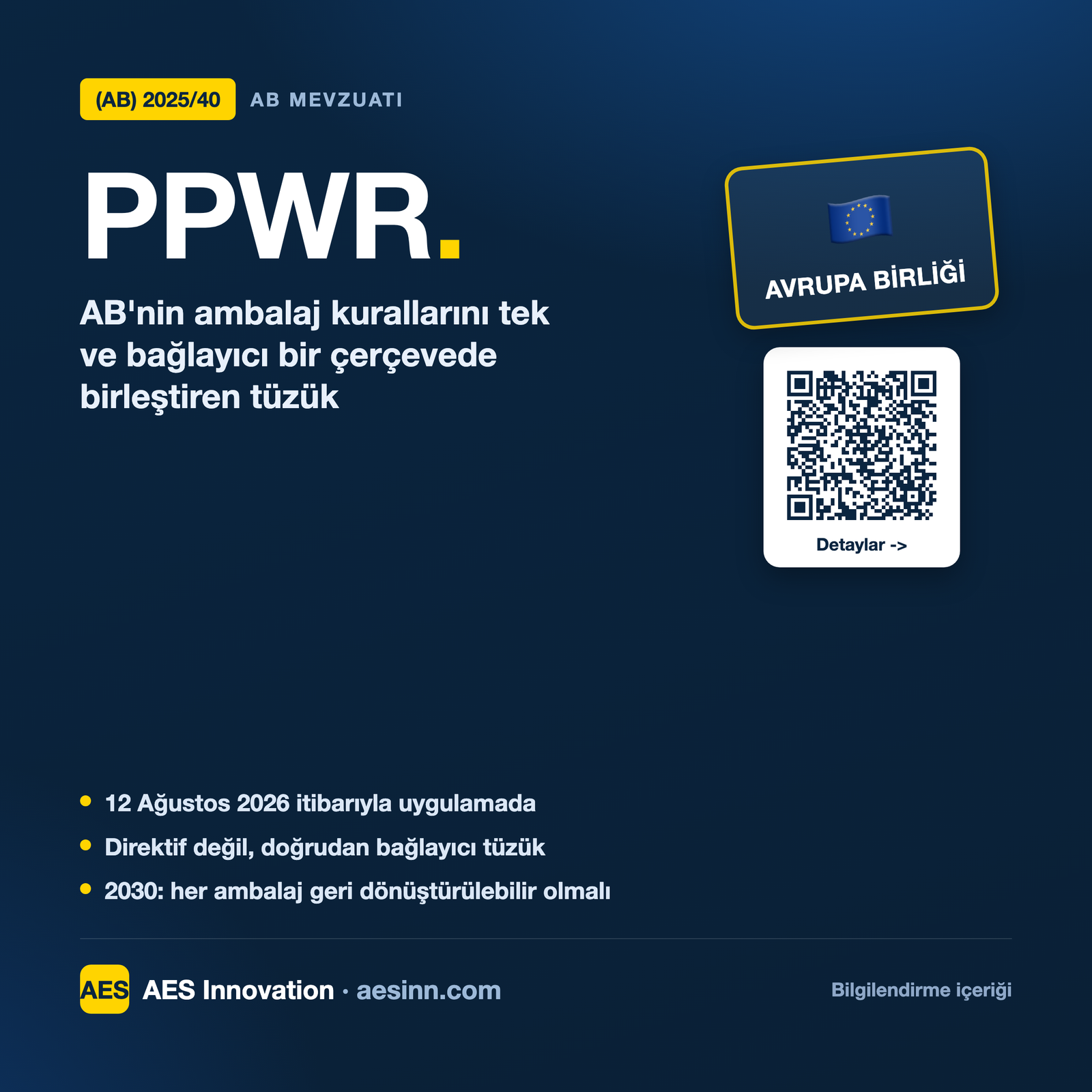
PPWR: EU Packaging and Packaging Waste Regulation and its Implications for Exporters
From directive to regulation: What is PPWR?
The European Union has retired the Packaging and Packaging Waste Directive 94/62/EC, which had been in effect for over thirty years, in order to reduce packaging waste and make packaging part of the circular economy. It has been replaced by Regulation (EU) 2025/40 – PPWR (Packaging and Packaging Waste Regulation) – adopted on 19 December 2024 and published in the Official Journal of the EU on 22 January 2025. The regulation entered into force on 11 February 2025 and became generally applicable as of 12 August 2026.
The most critical distinction here lies in the legal type: 94/62/EC was a 'directive', meaning each member state had to transpose it into its own national legislation; this resulted in different rules, different labeling, and different interpretations across the 27 countries. PPWR, on the other hand, is a 'regulation'; it applies directly and uniformly throughout the EU without the need for national transposition. This means a single, binding rulebook for packaging. PPWR also amends the Market Surveillance Regulation (EU) 2019/1020 and the Disposable Plastics Directive (EU) 2019/904.
Who will be affected?
The scope of PPWR is quite broad: all types of packaging placed on the EU market are subject to the rule. This includes sales (primary) packaging reaching the consumer, grouping (secondary) packaging containing multiple products, transport (tertiary) packaging, and e-commerce packaging. Different actors at different links in the chain have different obligations.
Turkish manufacturers exporting to the EU are considered 'non-EU manufacturers' under the regulations. Since the party actually placing the product on the EU market is mostly the importer in the EU, a significant portion of the legal obligations fall on the importer; however, designing compliant packaging, providing the necessary technical documentation and declaration of conformity are practically the manufacturer's responsibility. In short, packaging is now a compliance item that is checked along with the product.
- Packaging and packaging material manufacturers
- Manufacturers and bottling companies that are introducing packaged products to the EU market for the first time.
- Importers and distributors
- Online marketplaces and fulfillment service providers
- Operators in the waste collection and recycling chain
Essential obligations and changes
PPWR addresses packaging as a whole, from the design phase to the waste phase. Key responsibilities include:
- Recyclability (design for recycling): From 2030 onwards, all packaging placed on the market must be designed to be recyclable and meet performance class (A/B/C) criteria. Packaging that does not meet the threshold cannot be placed on the market; the criteria will be tightened in 2035 with the condition of 'recycling on a large scale', and in 2038 with a higher class requirement.
- Recycled content targets: From 2030, plastic packaging must contain specific percentages of post-consumer recycled plastic — for food-contact PET packaging, for non-PET contact-sensitive plastics, for single-use plastic beverage bottles, and for other plastic packaging. These percentages increase to , , , and respectively by 2040.
- Excessive packaging restrictions (void space ratio): From 2030, the void space ratio in grouping, transport, and e-commerce packaging can be a maximum of ; unnecessarily large boxes and packaging inflated with filler materials will be limited.
- Reuse targets: Reusability targets are set for specific packaging categories — for example, a certain percentage of transport packaging between operators must be reusable from 2030 onwards. Targets vary by product group and include various exemptions.
- Labeling: A harmonized material-composition label and pictograms showing the correct separation to the consumer will become mandatory (from approximately 2028). Rules such as separate labeling for reusable packaging and a declaration of recycled content will also be added.
- Hazardous substance restrictions: PFAS ('persistent chemicals') cannot be used above certain thresholds in food contact packaging; limits for heavy metals such as lead and cadmium persist.
- Ban on certain disposable plastic formats: From 2030, some formats will be banned — for example, disposable plastic packaging for fresh fruits and vegetables under 1.5 kg, disposable packaging for on-site consumption in cafes and restaurants, hotel miniature cosmetics, and very lightweight plastic bags.
Key dates (2026–2040)
PPWR is being implemented not in a single day, but with a phased timetable. Key milestones include:
- February 11, 2025: The regulations came into effect.
- August 12, 2026: General implementation began; Directive 94/62/EC was repealed; PFAS restrictions on food contact packaging and general packaging minimization rules came into effect.
- ~August 12, 2028: Mandatory harmonized material-composition labeling (subject to entry into force of relevant implementing measures).
- January 1, 2030: Recyclability criteria, recycled content targets, the empty space limit, reuse targets, and bans on certain single-use plastics will begin.
- 2035: 'Recycling on scale' assessment comes into play.
- 2038: A higher performance class in recyclability becomes mandatory.
- 2040: A second and higher threshold is applied to recycled content and reuse targets.
What does this mean for Turkish manufacturers?
Since the EU is Türkiye's largest export market, PPWR directly affects almost every sector exporting packaged products — from food and beverages to cosmetics, textiles to electronics. Buyers and importers in the EU will demand compliant packaging and accompanying documentation from their suppliers to meet their own obligations; this requirement is increasingly becoming a standard clause in contracts.
Therefore, preparing early provides a competitive advantage. Practical preparation steps include switching to recyclable mono-material design, selecting PFAS-free materials for food contact packaging, establishing a recycled content supply chain, designing packaging that reduces empty space, and preparing the labeling/documentation infrastructure. Learning the logic of technical files and declarations of conformity for packaging now will make it easier to reach the 2030 targets without surprises.
Brief comparison with 94/62/EC
To summarize the main differences between the two texts:
- Legal type: 94/62/EC was a directive requiring national transposition; PPWR is a directly implementing regulation.
- Harmonization: The directive led to 27 different national practices; the regulation introduces a single, uniform set of rules.
- Approach: While the directive primarily focused on recycling and recovery objectives, PPWR adds binding product-level obligations ranging from design to reuse, recycled content, and substance restrictions.
- New tools: Binding recyclability classes, recycled content ratios, free space limit, PFAS restriction, and harmonized labeling were not included in the directive.
Frequently Asked Questions
When did PPWR come into effect and when is it being implemented?
The regulation entered into force on February 11, 2025, and became generally applicable as of August 12, 2026. However, many obligations are coming into effect gradually in 2028, 2030, 2035, 2038, and 2040.
Which legislation does PPWR replace?
It replaces the Packaging and Packaging Waste Directive 94/62/EC, which has been in force for over thirty years. It also amends the Market Surveillance Regulation (EU) 2019/1020 and the Disposable Plastics Directive (EU) 2019/904.
Does this apply to a Turkish manufacturer exporting to the EU?
They are indirect but effective ties. When a product is placed on the EU market, the packaging must comply with regulations. Although much of the legal responsibility lies with the importer in the EU, it is practically the manufacturer's job to ensure compliant packaging and technical documentation.
What are the recycled content targets in plastic packaging?
From 2030, post-consumer recycled plastics with a ratio of to depending on the type will be mandatory; these ratios will increase to between and in 2040.
What is the excess packaging (empty space) rule?
From 2030 onwards, the maximum empty space ratio in grouping, transport, and e-commerce packaging can be 1 TP3T50; the aim is to limit unnecessarily large boxes and excessive filler materials.
This content is for informational purposes only and does not constitute a commitment to providing services or advice. Please contact us with any questions.