

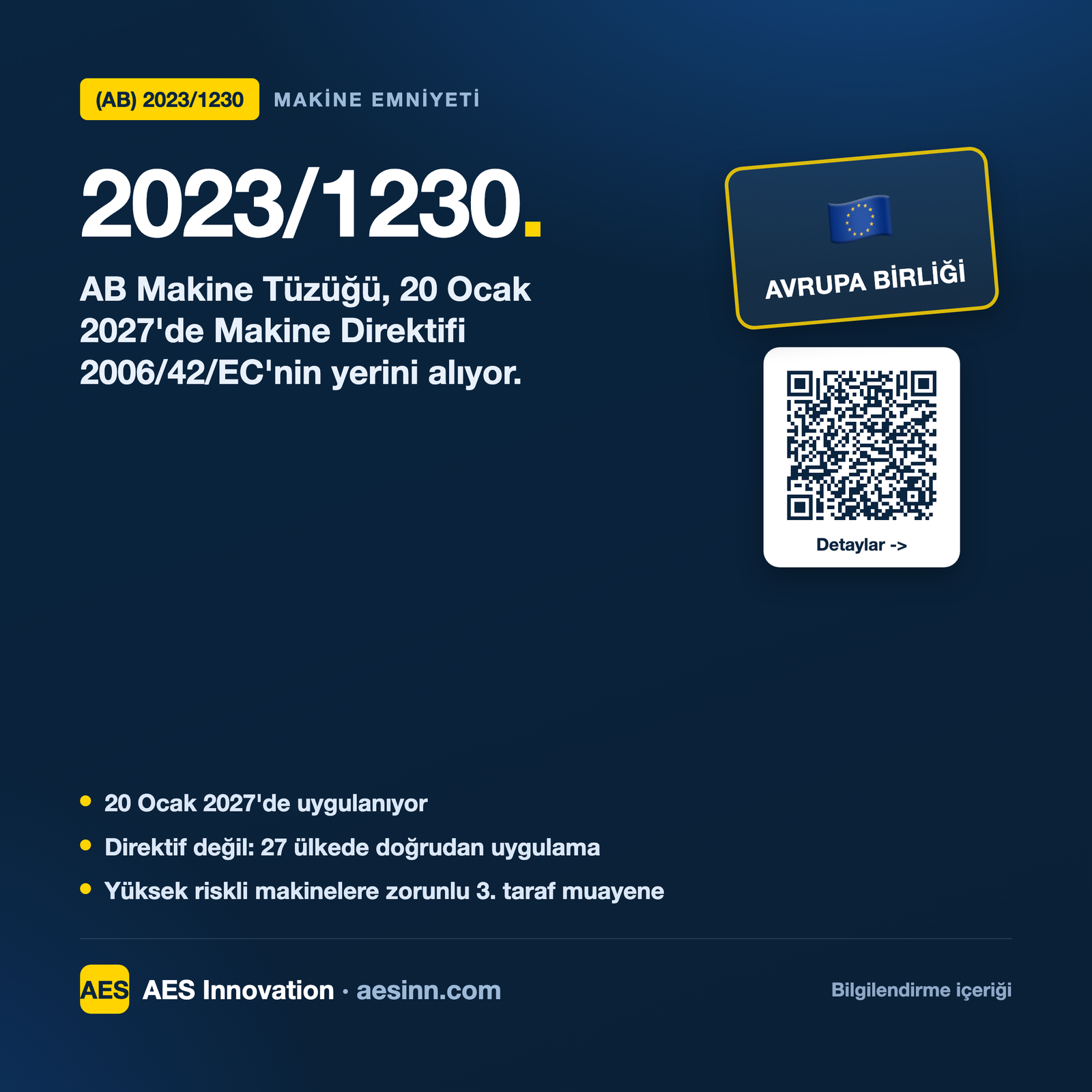
New EU Machinery Regulation (EU) 2023/1230: Guidance for Turkish Manufacturers until 2027
From 2006/42/EC (EU) to 2023/1230: What is changing?
The European Union is repealing the Machinery Directive 2006/42/EC, which has formed the basis of machinery safety for decades. It is being replaced by the Machinery Regulation (EU) 2023/1230, adopted on 14 June 2023 and published in the Official Journal of the EU (OJ L 165) on 29 June 2023. The regulation entered into force on 19 July 2023; however, the main obligations will begin to apply from 20 January 2027.
The most fundamental change lies in the legal instrument: it's no longer a 'directive', but a 'regulation'. While directives are transposed into national legislation by each member state individually, regulations are applied directly and uniformly across all 27 member states; they require no national transposition. This reduces differences in interpretation among member states and ensures more uniform application in the single market.
The changes are not merely formal. The regulations incorporate new, fundamental health and safety requirements that respond to the risks posed by digitalization, connected machines, artificial intelligence, and cybersecurity, which have rapidly become widespread in the last fifteen years.
Who will be affected?
The regulation covers all 'economic operators' supplying machinery and related products to the EU market. Following the logic of the New Legislative Framework, separate obligations are defined for each link in the chain.
- Manufacturers — both producers within the EU and producers in third countries (including Türkiye) exporting to the EU — are directly covered.
- Authorized representatives representing non-EU producers
- Importers and distributors — with verification and traceability responsibilities throughout the supply chain to the market.
- Parties that make 'substantial modifications' to a machine already on the market — these parties may assume the manufacturer's liabilities.
- Integrators who create machine assemblies by combining separate machines.
Key innovations and obligations
The regulation retains the general logic of 2006/42/EC while adapting the technical requirements to modern machinery. Key points include:
- Digital documentation: Operating instructions and the EU declaration of conformity can now be provided in digital/electronic format. However, if requested by the buyer, the manufacturer must provide printed instructions free of charge upon delivery; these instructions must remain accessible for the intended lifespan of the machine.
- Cybersecurity and protection against disruption: Security functions must be protected not only against failures and errors, but also against intentional or accidental disruption and malicious third-party interference. This has become an essential health and safety requirement.
- AI-powered machines and software: Software that performs security functions is considered a 'security component'. Machines with self-evolving behavior and AI-based security functions are explicitly included.
- Substantial modification: If a machine on the market undergoes a substantial modification that introduces a new hazard or increases an existing risk, it may be treated as a 'new machine', and the party making the modification assumes the manufacturer's obligations.
- Economic operator responsibilities: The duties of the manufacturer, authorized representative, importer, and distributor (technical file, risk assessment, traceability, cooperation with competent authorities, etc.) are defined separately and clearly.
High-risk machinery and mandatory third-party inspection (Annex I)
Annex IV of the Directive is now replaced by Annex I. High-risk machinery and related products are listed in this annex and are divided into two sections.
The most critical change is in Annex I, Section A: In these categories, the manufacturer's self-declaration—even if harmonized standards are fully implemented—is no longer sufficient. A third-party conformity assessment by a notified body is now mandatory before placing the product on the market. In the high-risk categories in Section B, self-assessment remains possible even if harmonized standards are fully implemented.
According to industry sources, there are approximately six categories in Part A that require absolute third-party inspection (e.g., certain safety components and AI systems with safety functions). Notified bodies are appointed by the EU; machine certification for the EU market is carried out through these bodies.
Important dates
The timeline for the regulations is progressing in stages; however, the main breaking point is 2027.
- June 14, 2023 — Adoption of the Statute
- 29 June 2023 — Published in the Official Journal of the EU (OJ L 165)
- July 19, 2023 — Entry into force (20 days after publication)
- January 20, 2024 — Early implementation of certain provisions relating to notified bodies.
- 20 January 2027 — Full implementation of the regulation and repeal of 2006/42/EC (end of approximately 42-month transition period)
What does this mean for Turkish manufacturers?
Turkish manufacturers exporting machinery to the EU are directly subject to the manufacturer obligations of the regulation. By 2027, the technical file needs to be reviewed, the risk assessment updated to include cybersecurity and (if applicable) artificial intelligence components, and the digital instruction infrastructure prepared.
If a high-risk (Annex I, Section A) machine is being exported, a third-party conformity assessment with an EU-designated notified body must be planned in advance; this step directly affects the supply and market entry timeline. Monitoring current harmonized standards lists is also crucial in this process.
Regardless of the regulations governing the machine, the safety of its electrical equipment is an unchanging technical principle. EN 60204-1 (Electrical equipment in machinery – general rules) is the reference standard in this area, and AES engineers, with their CMSE (Certified Machinery Safety Expert) qualifications, provide expert assessments. AES is a TÜRKAK-accredited Type A electrical inspection body; machine conformity assessment and CE certification fall under the purview of approved bodies appointed by the EU. AES's contribution is limited to field and engineering expertise in the electrical safety aspect.
2006/42/EC and (EU) 2023/1230: key differences
In short, January 20, 2027, is a sharp threshold without a separate transition period: From that date onwards, processes carried out under 2006/42/EC need to be reviewed in accordance with the new regulation.
- Legal instrument: Directive (transposition into national legislation) → Regulation (direct implementation in 27 countries)
- Documentation: Primarily printed instructions → Digital instructions are the main method, free printed instructions available upon request.
- Cybersecurity: Limited/Implicit → Protection against disruption and attack is a fundamental requirement.
- Artificial intelligence and software: Unclear scope → Software that performs a security function is the 'security component', AI is clearly within the scope.
- High-risk list: Annex IV → Annex I (Section A mandatory third party, Section B flexible)
- Machine modification: Legal uncertainty → 'Significant modification' is defined and creates liability.
Frequently Asked Questions
When does (EU) 2023/1230 come into effect?
The regulation entered into force on 19 July 2023, but the main obligations apply as of 20 January 2027. On the same date, the Machinery Directive 2006/42/EC repeals itself.
Is the Machinery Directive 2006/42/EC still valid?
Yes, it is valid until January 19, 2027. From January 20, 2027 onwards, it will be replaced by the new regulation, and no separate transition period will be granted; after that date, market supply will be conducted according to the new regulation.
Is the manufacturer's self-declaration sufficient for high-risk machinery?
In the categories in Annex I, Part A, no. Third-party conformity assessment by a notified body is mandatory even if the harmonized standards are fully implemented. In Part B, however, self-assessment remains possible even if the standards are fully implemented.
Is providing the instructions digitally sufficient?
As a rule, yes; the instructions for use and the EU declaration of conformity can be provided in digital format. However, if the buyer requests it, the manufacturer is obliged to provide a printed copy free of charge upon delivery.
Does AES provide CE certification or notified body services for its machines?
No. AES is a TÜRKAK-accredited Type A electrical inspection body; machine CE/conformity assessment falls within the purview of notified bodies appointed in the EU. AES's role is limited to CMSE expertise in machine electrical safety under EN 60204-1.
This content is for informational purposes only and does not constitute a commitment to providing services or advice. Please contact us with any questions.