
Export to the USA: FCC, UL/NRTL and CPSC
The EU logic doesn't work here: Why is the system different in the US?
In the European Union, the CE mark relies largely on the manufacturer's own declaration of conformity; only in high-risk product categories does a Notified Body become involved. Harmonized standards also provide a 'presumption of conformity'. In the US, however, there is no such single unified mark or broad self-declaration logic.
In the United States, jurisdiction is distributed among different federal agencies (FCC, CPSC, FDA) depending on the product, and for most products, independent third-party/laboratory testing results are the basis. On top of that, there's a strong layer of private law: state regulations like California Prop 65 and product liability lawsuits can create risks even if you've completed federal compliance. In short, exporting to the US isn't just about getting a document and being done with it; it's about creating a layered compliance roadmap.
- Electronic/electrical equipment manufacturers: FCC (EMC/RF) + NRTL (electrical safety)
- Toys, children's products, textiles/clothing, furniture: CPSC / CPSIA + Prop 65
- Food, food supplements, cosmetics, medical devices: FDA
- Almost every product that reaches California through any channel: Prop 65
FCC: Electromagnetic compatibility in electronic and radio equipment.
The FCC (Federal Communications Commission) regulates virtually all electronic devices that generate or emit radio frequencies; the basic framework is 47 CFR Part 15. The system is divided into two different paths: Certification for intentional radiators and Supplier's Declaration of Conformity (SDoC) for unintentional radiators.
Certification is required for devices that intentionally emit RF, such as Wi-Fi, Bluetooth, cellular modems, and radio modules; it is conducted through a Telecommunication Certification Body (TCB) recognized by the FCC, and an FCC ID is assigned to the device. SDoCs, on the other hand, are for 'unintentional radiators' that produce RF solely for internal use, such as digital circuits, computers, switched-mode power supplies, and many IT equipment; no application file is submitted to the FCC, and a test report and proof of compliance are provided upon request.
- For an SDoC (State of Emergency Conduct), the 'responsible party' must be based in the United States.
- Foreign manufacturers must appoint a 'service of process' representative (US agent) in the US when applying for certification (FCC Part 2.911(d)(7)).
- In 2017, the FCC eliminated the old 'Verification' and 'DoC' processes and combined them into the SDoC framework.
- Labeling: The certified device includes the FCC ID and the declaration of compliance text stipulated in the SDoC.
UL/NRTL: What does 'UL certificate' actually mean?
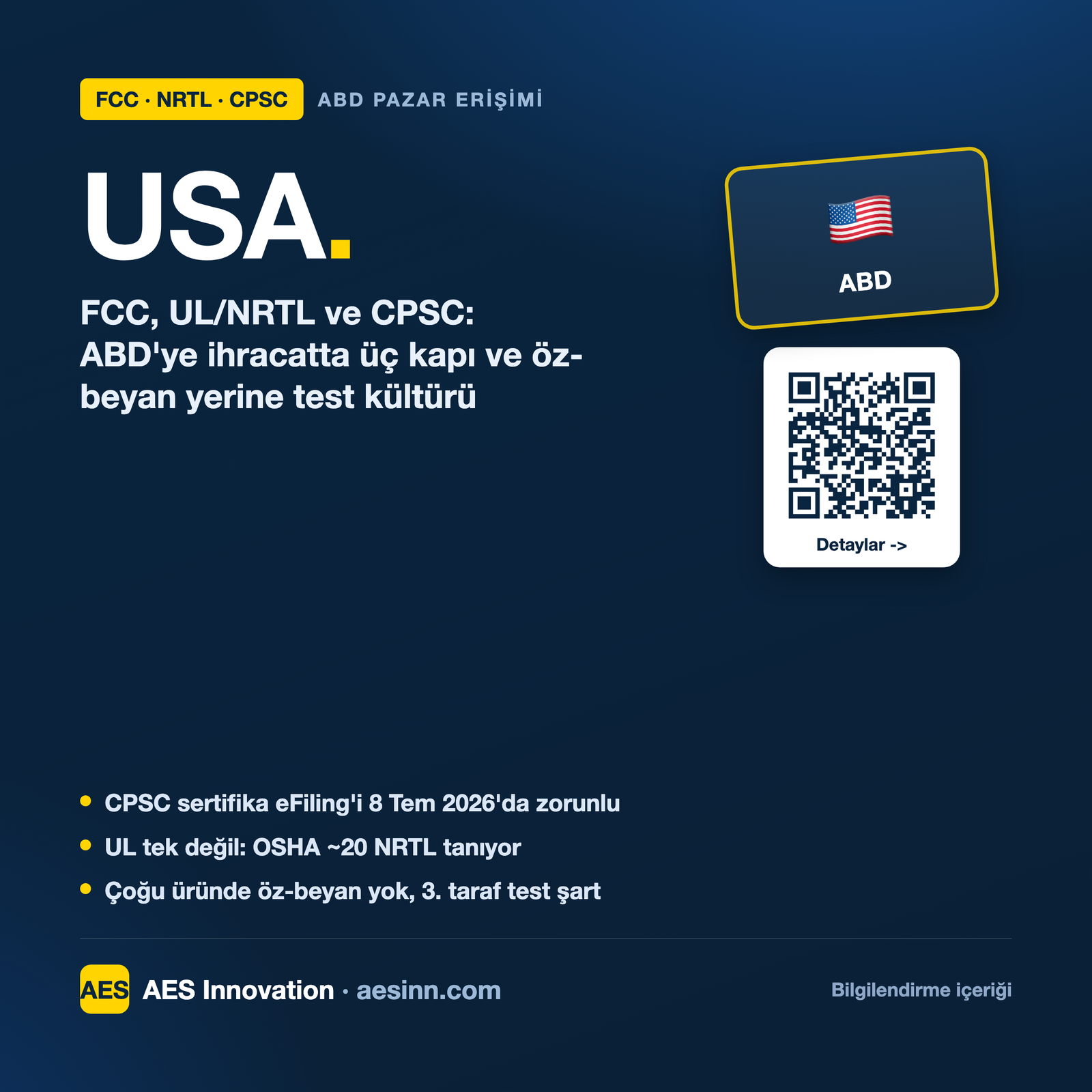
In the market, the term 'UL certification' is often used as the equivalent of US electrical safety certification; however, the technical reality is different. In the US, the umbrella for electrical safety certification is the NRTL (Nationally Recognized Testing Laboratory) program run by OSHA (Occupational Safety and Health Administration), and its legal basis is 29 CFR 1910.7. UL is only one of approximately 20 NRTLs recognized by OSHA; organizations such as Intertek (ETL brand), CSA, TÜV SÜD, TÜV Rheinland, and MET are also considered 'equivalent' within their scope.
The NRTL 'listing/labeling' requirement originates from OSHA 29 CFR 1910.303 and Article 110.3 of the National Electrical Code (NEC), which require electrical equipment in workplaces to be listed and labeled. Because the NEC is incorporated into state and local electrical codes, in practice, the scope of your equipment is expected to be listed by an appropriate NRTL.
An important nuance: there is no single, direct 'federal NRTL requirement' for consumer products. However, since retailers, insurers, and local authorities (AHJs) require an NRTL mark (UL, ETL, etc.), this effectively becomes a market and responsibility requirement. As a TÜRKAK-accredited Type A electrical inspection body, AES can offer expert support in pre-export preparation and gap analysis on the machine and plant electrical safety side (EN 60204-1 machine electrical equipment framework, CMSE approach). NRTL listing itself is done by the relevant NRTL.
- NRTL = OSHA-recognized umbrella of testing/certification laboratories (29 CFR 1910.7).
- UL is not the only option; any NRTL designation with appropriate scope will be accepted.
- Legal basis: OSHA 29 CFR 1910.303 + NEC 110.3 (introduction to local codes).
- In consumer products, the main pressure comes from retailer, insurer, and local AHJ (Automated Consumer Safety) requirements.
CPSC and CPSIA: Consumer product safety and mandatory certifications.
The CPSC (Consumer Product Safety Commission) is the federal agency responsible for the general safety of consumer products. Regulations were significantly tightened with the CPSIA (Consumer Product Safety Improvement Act) of 2008. There are two main certificates of conformity: the CPC (Children's Product Certificate) for children's products and the GCC (General Certificate of Conformity) for non-children's products subject to CPSC regulations.
CPC is mandatory for children's products designed for ages 12 and under and must be based on test results from an independent (third-party) laboratory accepted by the CPSC. GCC may be based on a test or a reasonable testing program; there is no third-party laboratory requirement. Key ingredient limits and guidelines are as follows:
A final and crucial development: As of July 8, 2026, the electronic submission (eFiling) of certificates of conformity to U.S. Customs and Border Protection (CBP) for imports becomes mandatory (16 CFR Part 1110; the rule was published in the Federal Register on January 8, 2025). The deadline for entry from the Free Zone (FTZ) to consumption/storage is January 8, 2027. This requires exporters to have certificate data digitally available at customs clearance.
- Total lead content in children's products: ≤ 100 ppm (as of August 14, 2011).
- Lead in paint/surface coating: ≤ 90 ppm.
- Phthalates in certain children's products: ≤ %0,1.
- ASTM F963 is a mandatory safety standard for toys.
- Tracking labels are required for children's products.
- eFiling certificates (CBP) will be mandatory from July 8, 2026.
FDA and California Prop 65: Two layers overlooked
The FDA (Food and Drug Administration) operates entirely separate regimes for food, food supplements, cosmetics, and medical devices. These product groups are subject to FDA requirements directly, not FCC or CPSC requirements, and most require a responsible person/representative based in the United States.
California Prop 65 (the Safe Drinking Water and Toxic Enforcement Act of 1986) is a state, not a federal, regulation; however, its effect is effectively national because it covers the largest state market in the US. If exposure to a substance on the OEHHA's list of approximately 900 chemicals known to cause cancer or harm reproductive health occurs, a 'clear and reasonable' warning is required on the product. Compliance is achieved through 'safe harbor' warning texts as defined in the regulation. On January 1, 2025, the short-form warning rules were updated; now, the warning must name at least one chemical (a transition period was provided for the old format).
- Food: facility registration (annual renewal), prior notice, and the FSVP program where the importer verifies the foreign supplier.
- Cosmetics: Facility registration + product listing with MoCRA dated December 29, 2022, US responsible person, safety justification and adverse event reporting.
- Medical device: facility registration + device listing, 510(k) or PMA by class, US agent for foreign manufacturer and UDI.
- Prop 65 violations are often pursued by private 'penalty hunter' plaintiffs; the 60-day notice period plus settlement can be very costly.
Key dates and recent developments
Because the US system is layered, keeping track of timelines is critical; both established thresholds and newly enacted rules directly impact planning. In particular, the CPSC eFiling requirement, which comes into effect in 2026, is a recent development that is changing customs processes today.
- 1986: California Prop 65 was adopted.
- 2008: CPSIA became law.
- August 14, 2009: Lead limit in paint/coatings 90 ppm; total lead in children's products 300 ppm.
- August 14, 2011: The total lead limit in children's products was reduced to 100 ppm.
- 2017: The FCC replaced the Verification/DoC with the SDoC.
- December 29, 2022: MoCRA in cosmetics became law (most of the provisions came into effect at the end of 2023).
- January 1, 2025: Updated (short-form) warning rules of Prop 65 come into effect.
- July 8, 2026: CPSC eFiling certification becomes mandatory (January 8, 2027 for free zone entries).
What does this mean for Turkish manufacturers?
The biggest change when moving from the EU to the US should be in mindset: the "I'll just put the CE mark on my own declaration" reflex won't work here. Most products require independent laboratory testing, a responsible party/representative based in the US, and product-specific certification preparation. Setting things up correctly from the start prevents surprises at customs and in the market.
- Match your product with the correct agency: electronics/wireless > FCC; electrical safety > NRTL; general consumer product > CPSC; food/cosmetics/appliances > FDA.
- Plan ahead for any third-party testing requirements; check the scope of the CPSC-approved laboratory and relevant NRTL beforehand.
- In the US, resolve the representative/responsible party requirement from the outset: FCC US agent, FDA US agent, SDoC responsible party.
- Clarify Prop 65 and labeling requirements with the buyer during the contract phase.
- Keep your certificate data digital and customs-ready in accordance with the CPSC eFiling requirement of July 8, 2026.
- Brief comparison: EU single CE mark + broad self-declaration; US single mark, no mark, agency-based + test-heavy. Notified Body alone in the EU is a high risk; third-party testing is virtually mandatory on most products in the US. Harmonization is largely administrative in the EU; private law (Prop 65, product liability) is a major risk factor in the US.
Frequently Asked Questions
ABD’de ‘CE gibi tek bir işaret’ var mı?
No. There is no single unified mark. Depending on the product, there are separate agency and product-specific requirements such as FCC ID, NRTL marking (UL/ETL etc.) and CPSC compliance certificates (CPC/GCC).
Do I absolutely have to obtain 'UL certification'?
UL is not the only mandatory option. OSHA recognizes approximately 20 NRTLs as equivalent (such as Intertek/ETL, CSA, TÜV SÜD, TÜV Rheinland, MET). The mark of any NRTL with appropriate scope is accepted.
Does each device require separate FCC approval?
Intentional radiators emitting RF (Wi-Fi, Bluetooth, radio) require certification and FCC ID; digital/unintentional radiators are generally declared via SDoC. Foreign manufacturers appoint a US agent for certification.
I export children's products; what are the requirements?
Third-party laboratory testing approved by the CPSC and a Children's Product Certificate (CPC) are required. Rules such as lead 100 ppm, 90 ppm in paint, ASTM F963 for toys, and traceability labeling apply.
I'm not selling directly to California, would the Prop 65 interest me?
This is relevant if your product can reach California through any channel. Due to the warning obligation and the risk of private litigation, it would be appropriate to conduct a product-specific Prop 65 assessment.
This content is for informational purposes only and does not constitute a commitment to providing services or advice. Please contact us with any questions.