

UKCA Marking and UK Compliance: A Simplified Guide for Exporters
What is the UKCA symbol and why did it come about?
UKCA (UK Conformity Assessed) is the United Kingdom's own conformity mark created after its departure from the European Union. The Brexit transition period ended on 31 December 2020; the UKCA mark became available from 1 January 2021. The mark is designed to cover a large range of 'new approach' products previously assessed under CE: machinery, electrical equipment, low-voltage devices, EMU (electromagnetic compatibility), radio equipment, pressure equipment, toys, PPE (personal protective equipment) and more.
A critical geographical distinction exists: the UKCA applies only to the Great Britain market (i.e., England, Wales, and Scotland). Northern Ireland is outside this regime; EU rules under the Windsor Framework continue to apply there, and the CE (and UKNI where applicable) marking is valid. Therefore, it is necessary to distinguish between the concepts of 'United Kingdom' and 'Great Britain (GB)' in the context of conformity.
Initially, UKCA was planned to become mandatory after a specific date. This date was first set as January 1, 2023, then December 31, 2024, and was repeatedly postponed. It is at this point that the most significant change for exporters occurred.
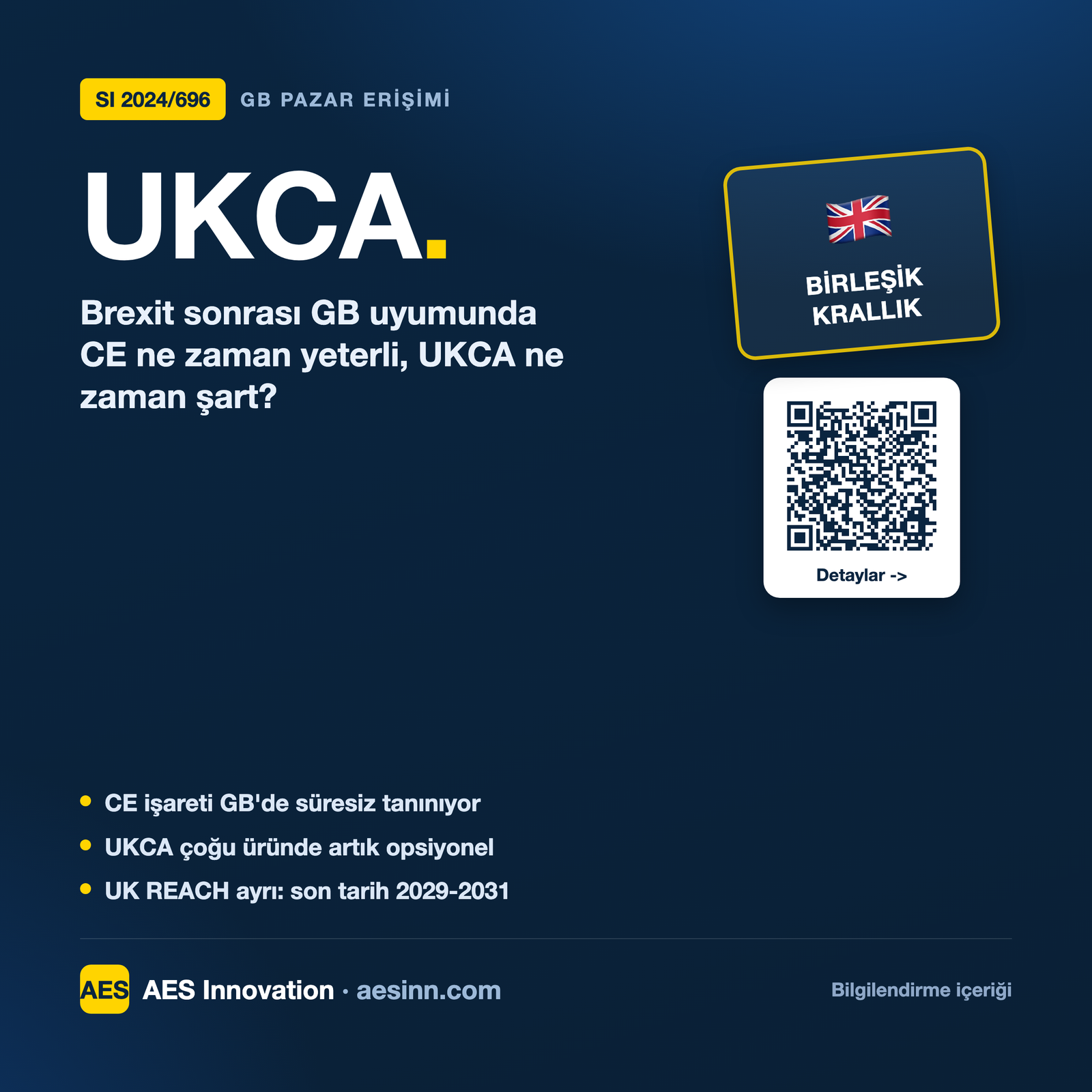
The most crucial point: The CE mark is recognized indefinitely in the UK.
This is a common misconception among exporters: the United Kingdom continues to recognize the CE mark indefinitely for many product categories. This policy, announced on 1 August 2023, was formalized by The Product Safety and Metrology etc. (Amendment) Regulations 2024 (SI 2024/696), which were adopted on 23 May 2024 and entered into force on 1 October 2024.
The regulation's function is clear: it removes the 31 December 2024 deadline for CE mark recognition. As a result, the CE mark on covered products is indefinitely accepted in the UK market; manufacturers can use either CE or UKCA. This flexibility directly affects 18 product regulations under the Department for Business and Trade (DBT), and a total of up to 21 product categories are covered by the regulation.
In practice, this means that a Turkish manufacturer who already has a CE mark for the EU market can place products with the same CE mark on the UK market within the scope of this agreement; they are not also required to obtain a UKCA (United Kingdom Insurance Commission). For these product groups, a UKCA is no longer mandatory, but an optional choice.
- CE and UKCA are considered equivalent in GB: the manufacturer chooses one, not both.
- Indefinite recognition; meaning there is currently no 'CE expiration date'.
- CE recognition for construction materials has also been made indefinite with a separate government announcement dated September 2, 2024.
- The scope includes most 'new approach' products: machinery, LVD, EMU, radio equipment, PPE, pressure equipment, toys, ATEX, etc.
2026-2027 Update: GB Machine Regulation and New Framework Law
The United Kingdom has maintained its policy of indefinite recognition of the CE mark in Great Britain (GB) for the period 2025-2026; no withdrawal or new deadline has been introduced. However, a significant regulation for machinery products has been published: The Supply of Machinery (Safety) (Amendment etc.) and the EU Machinery Regulation (Enforcement etc. in Northern Ireland) Regulations 2026 (SI 2026/867). This regulation will enter into force on 20 January 2027.
The regulation has two main functions. Firstly, it ensures the implementation of the EU's new Machinery Directive (EU) 2023/1230 (replacing the Machinery Directive 2006/42/EC) within the Windsor Framework in Northern Ireland. Secondly, it provides machine manufacturers in the UK with a dual compliance pathway: manufacturers can place their products on the market either according to the existing Supply of Machinery (Safety) Regulations 2008 or the requirements of the updated EU Machinery Directive. Thanks to this flexibility, the recognition of CE-marked machines in the UK is maintained, and businesses can continue to use either the UKCA or CE mark.
Furthermore, at the framework level, the Product Regulation and Metrology Act 2025 (Royal Assent 21 July 2025) has entered into force. This act empowers ministers to determine UK product requirements through secondary legislation and to decide on a case-by-case basis whether to continue recognizing changes in EU rules. The act does not directly alter the current indefinite recognition of CE; however, it determines the legal mechanism by which recognition decisions will be updated in the future. This forms the legal basis for the scenario described in the text, where 'UKCA would actually become necessary in the event of a divergence of UK rules from the EU'.
- SI 2026/867: GB machine regulation effective January 20, 2027.
- In the UK, there is a dual path for machinery: Supply of Machinery (Safety) Regulations 2008 OR EU Machinery Directive (EU) 2023/1230. Compliance with the EU regulation is optional in the UK.
- In Northern Ireland, the EU Machinery Directive (EU) 2023/1230 applies directly (Windsor Framework).
- CE mark recognition on machinery is maintained in GB; flexibility between UKCA and CE continues.
- Product Regulation and Metrology Act 2025 (21 July 2025): A framework law granting ministers the power to decide on a case-by-case basis on the recognition of changes to EU rules.
So when is UKCA really necessary?
CE marking is not a permanent recognition; it does not cover every situation. There are three main scenarios where UKCA is still truly necessary or decisive, and this is where the exporter should pay the most attention.
Firstly, there is the divergence between GB rules and EU rules. The CE mark indicates that the product meets EU requirements. If GB differentiates its own rules for a particular product from the EU, a CE mark based solely on EU requirements is insufficient to prove GB conformity; in this case, the product must be assessed according to GB requirements and carried out by UKCA. Secondly, third-party assessment must be carried out by a UK Approved Body. These bodies, authorized by UKAS, can only provide certification for UKCA; they cannot issue CE marks. Thirdly, there are product areas that fall outside the scope of reduced recognition and have their own separate regime.
- Medical devices: MHRA's separate regime; CE-certified devices are accepted with transition periods (dates below)
- Construction materials: separate legislation, but CE recognition is still valid indefinitely.
- Cableways, marine equipment, railway products.
- Portable pressurized equipment and uncrewed aircraft systems.
- The rule is: always confirm whether your product falls within the scope of CE recognition according to your own regulations; not every product is automatically covered.
Who will be affected?
This framework applies only to those who are physically placing their products on the Great Britain (GB) market for the first time. Manufacturers exporting from Türkiye to the GB, companies importing these products into the GB, and distributors within the GB are directly covered. Supply to Northern Ireland is subject to different rules (EU regime + UKNI where applicable).
Manufacturers of electrical equipment, machinery, low-voltage products, EMU-related devices, radio equipment, PPE, toys, and pressure equipment are among the most commonly affected groups. The good news is that for most of these products, the CE mark is sufficient under GB regulations, meaning exporters don't have to bear the additional cost of marking. However, the picture is different for companies importing chemicals or supplying products containing chemicals; they are also subject to UK REACH regulations.
Important dates and transition arrangements.
There is currently no binding 'deadline' for the conformity mark itself (CE or UKCA); what matters are ease of labeling and sector-specific transition periods.
Significant labeling flexibility for general products ends on 31 December 2027 (23:00): until this date, the UKCA mark may be placed on a label or accompanying document attached to the product, rather than directly on the product itself; similarly, importer information may be printed on accompanying documents, not directly on the product. After this date, the relevant information is expected to be directly on the product.
A separate and phased timetable applies to medical devices: for devices conforming to older directives (MDD 93/42/EEC, AIMDD 90/385/EEC), CE is accepted in GB until the expiry of the certificate or at the latest by 30 June 2028 (whichever comes first); for devices under the EU MDR (2017/745), by 30 June 2030; and for in vitro diagnostic devices under the EU IVDR (2017/746), also by 30 June 2030. MHRA updates its regulations on the recognition of CE-certified medical devices; please confirm the current MHRA guidance.
- January 1, 2021: UKCA launched; UK REACH began.
- August 1, 2023: It was announced that CE will be recognized indefinitely.
- October 1, 2024: SI 2024/696 enters into force — CE's December 31, 2024 deadline is removed.
- September 2, 2024: CE recognition for construction materials is indefinite.
- December 31, 2027 (23:00): On-label flexibility for UKCA/importer information ends.
- June 30, 2028: Legacy MDD/AIMDD devices · June 30, 2030: CE approval deadlines for EU MDR devices and IVDR IVDs (according to MHRA guidance)
UK REACH: a separate and independent regime for chemicals.
UK REACH is an entirely separate issue from conformity marking and is often confused with it. Since January 1, 2021, it has been its own chemical registration regime, managed by the HSE (Health and Safety Executive), operating independently from EU REACH. A product bearing CE or UKCA marking does not relieve it of UK REACH obligations for the chemicals it contains.
There are two main transition mechanisms for companies supplying chemicals to the UK: 'grandfathering', which allows existing EU REACH registrations to be recognized under UK REACH, and DUIN (Downstream User Import Notification) notification for UK downstream users/distributors who wish to continue importing from the EU. The final registration obligation is subject to staggered deadlines.
Transitional registration deadlines have been extended. The current schedule is set as 27 October 2029, 27 October 2030, and 27 October 2031, according to tonnage and hazard profile: the highest tonnage and highest risk substances (e.g., CMRs) in 2029, medium-level substances in 2030, and all other substances above 1 tonne annually in 2031. The government is also working on an alternative transition model (ATRm) aimed at reducing registration data costs.
What does this mean for Turkish manufacturers?
The summary message is reassuring: for most Turkish manufacturers exporting to the UK market, the CE mark is still sufficient, and obtaining a UKCA (United Kingdom Certification) is unnecessary for most products. Maintaining a CE file for the EU opens the door to the UK market for the products within its scope. This is a significant advantage in terms of avoiding additional certification costs.
However, do not neglect three checks: (1) Is your product covered by CE recognition legislation, or is it under a separate regime such as a medical device/construction material? (2) Has the GB introduced a different rule for your product than the EU? (3) Is your third-party assessment by an EU Notified Body, or are you in a situation requiring a UK Notified Body for the GB? On the chemical side, UK REACH obligations should be assessed separately, independently of marking.
A practical reminder regarding machinery exports: Electrical safety is among the essential health and safety requirements that machinery must meet under CE or UKCA standards, with EN 60204-1 as the technical reference. AES, as a TÜRKAK-accredited Type A electrical inspection body, provides expert assessment support in the field of electrical safety for machinery (within the framework of EN 60204-1). This support is not part of product certification or CE/UKCA marking; it is an independent inspection contribution focusing on the technical safety evidence that forms the basis of the conformity mark.
Frequently Asked Questions
Is the UKCA mark mandatory for exporting to the GB market?
For most products, no. The UK continues to recognize the CE mark indefinitely in the product areas covered by the regulation (SI 2024/696) in 2024. You can use either CE or UKCA on these products; UKCA is optional.
Is the CE mark I obtained for the EU also sufficient for the Great Britain (GB)?
For most products under the new approach, yes, and indefinitely. There are exceptions: areas with their own regime, such as medical devices and building materials; situations where UK regulations diverge from EU regulations; and cases where the assessment must be carried out by a UK Notified Body. First, confirm that your product legislation is within the scope.
So when exactly is UKCA really necessary?
In three main cases: when GB requirements diverge from EU requirements (CE alone is not sufficient), when a third-party assessment is carried out by a UK Notified Body (these bodies can only issue UKCA, not CE), and when the product is subject to a separate regime outside the scope of CE recognition.
Is UK REACH the same as the CE/UKCA mark?
No. UK REACH is a separate chemical registration regime managed by HSE and is independent of labeling. There are grandfathering and DUIN mechanisms for suppliers of chemicals to the UK; transitional registration deadlines are 27 October 2029, 2030 and 2031 depending on tonnage and hazard.
Are the rules different for Northern Ireland?
Yes. UKCA is only for Great Britain (England, Wales, Scotland). In Northern Ireland, EU rules under the Windsor Framework apply and the CE (and UKNI where applicable) marking is used.
This content is for informational purposes only and does not constitute a commitment to providing services or advice. Please contact us with any questions.
Can I still use the CE mark for machinery (machine products) in the UK?
Yes. The CE mark is granted indefinitely and also covers machinery. Furthermore, with SI 2026/867, which will enter into force on 20 January 2027, manufacturers can place their products on the market in the UK by ensuring compliance with the existing Supply of Machinery (Safety) Regulations 2008 or the updated EU Machinery Directive (EU) 2023/1230; the flexibility between UKCA and CE remains. (For objective information; for final assessment, official gov.uk/legislation.gov.uk resources and an authorized conformity assessment body should be consulted.)
Does the Product Regulation and Metrology Act 2025 change CE recognition?
No, it doesn't directly change anything. This law is a framework statute: it empowers ministers to decide whether to continue defining GB product requirements through secondary legislation and recognizing changes in EU rules. The current indefinite recognition of CE remains in effect; the law establishes the legal mechanism for future recognition decisions.