

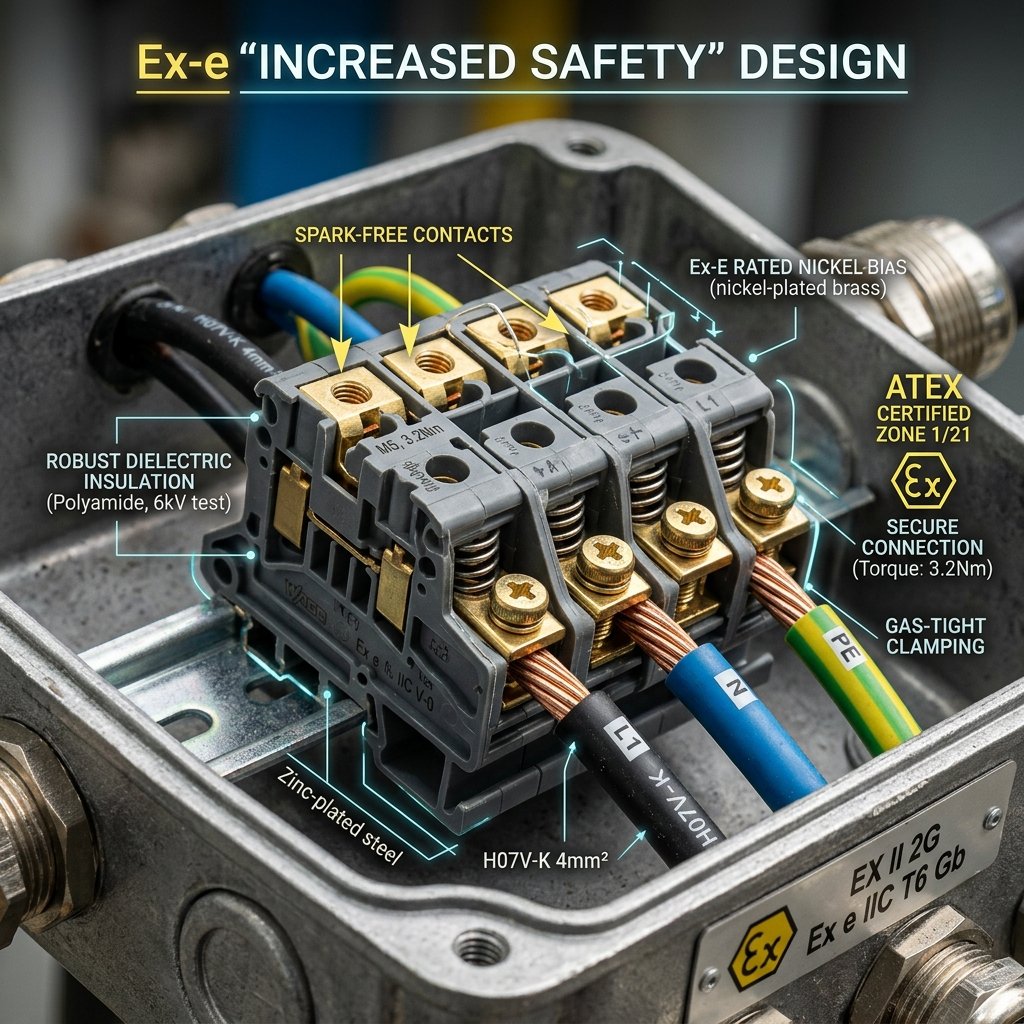
What is IEC 60079-7? Enhanced Safety (Ex e) Protection Type.
Short answer: IEC 60079-7 is for equipment used in explosive atmospheres. Enhanced Safety (Ex e) It defines the type of protection. In equipment that does not produce sparks or dangerous temperatures during normal operation, the possibility of arcs/sparks is minimized through additional design measures. The philosophy is clear: to prevent sparks from forming in the first place, rather than simply containing them.
There are multiple ways to protect electrical equipment in explosive environments, and one of the most elegant is Enhanced Safety. The flameproof (Ex d) method assumes an explosion will occur inside and contains it within a robust enclosure. Ex-e, however, operates on a different principle: if equipment doesn't already produce sparks, arcs, or dangerous temperatures during normal operation, we can make it even safer by preventing it from becoming an ignition source even in foreseeable failure situations. This approach offers both lighter and generally more economical solutions.
Therefore, Ex-e protection is most common. in junction and terminal boxes, lighting fixtures, and cage rotor asynchronous motors They are preferred. A common feature of this equipment is that it does not produce sparks while operating properly. Danger only arises when a foreseeable failure occurs, such as a loosening, overload, or insulation weakening. The Ex-e design adds an extra safety margin against precisely these foreseeable failure scenarios.
Ex-e's Basic Design Criteria
Enhanced safety is based on concrete design principles. Insulation distances The clearance distance (overhead jump distance) and creepage distance (surface jump distance) are kept significantly larger than in conventional equipment; thus, the risk of crosstalk between conductors is reduced. Terminals, They are designed with spring contacts or intrinsically safe compression structures that do not loosen under vibration; because a loosened connection means heating and arcing. All surface temperatures are limited to remain below the ignition temperature of the ambient gas, and the equipment is subject to change. temperature class (T1–T6) It is documented.
The Critical Point in Ex-e Engines: tE Time
The most important concept in Ex-e engines tE is the duration: the time it takes for the winding to reach the maximum allowable temperature when the motor enters a locked rotor (stall) state. The safety of the motor depends not only on its own design but also on the components that power it. correct setting of the protection relay It is also connected; the relay must be set to de-energize the motor before the winding tE time is exceeded. An incorrectly configured thermal protection can turn even a certified Ex-e motor into an ignition source. Therefore, during periodic inspections, the motor certification, tE value, and protection setting are verified together.
Frequently Asked Questions
What is the difference between Ex-e and Ex-d (flameproof)?
Ex-d a possible explosion inside traps it inside a case; Ex-e means spark. never to occur targets. Ex-e is generally lighter and more economical, but it is only applicable to equipment that does not normally produce sparks.
Is Ex-e equipment subject to periodic inspection?
Yes. Like all Ex protection types under IEC 60079-17, Ex-e equipment undergoes periodic inspections; specifically, terminal tightness, insulation status, and protection settings are checked.
Secure your Ex-e Equipment with Accredited Inspection
Related service: Explosive Atmosphere (ATEX/Ex-Proof) Inspections.