

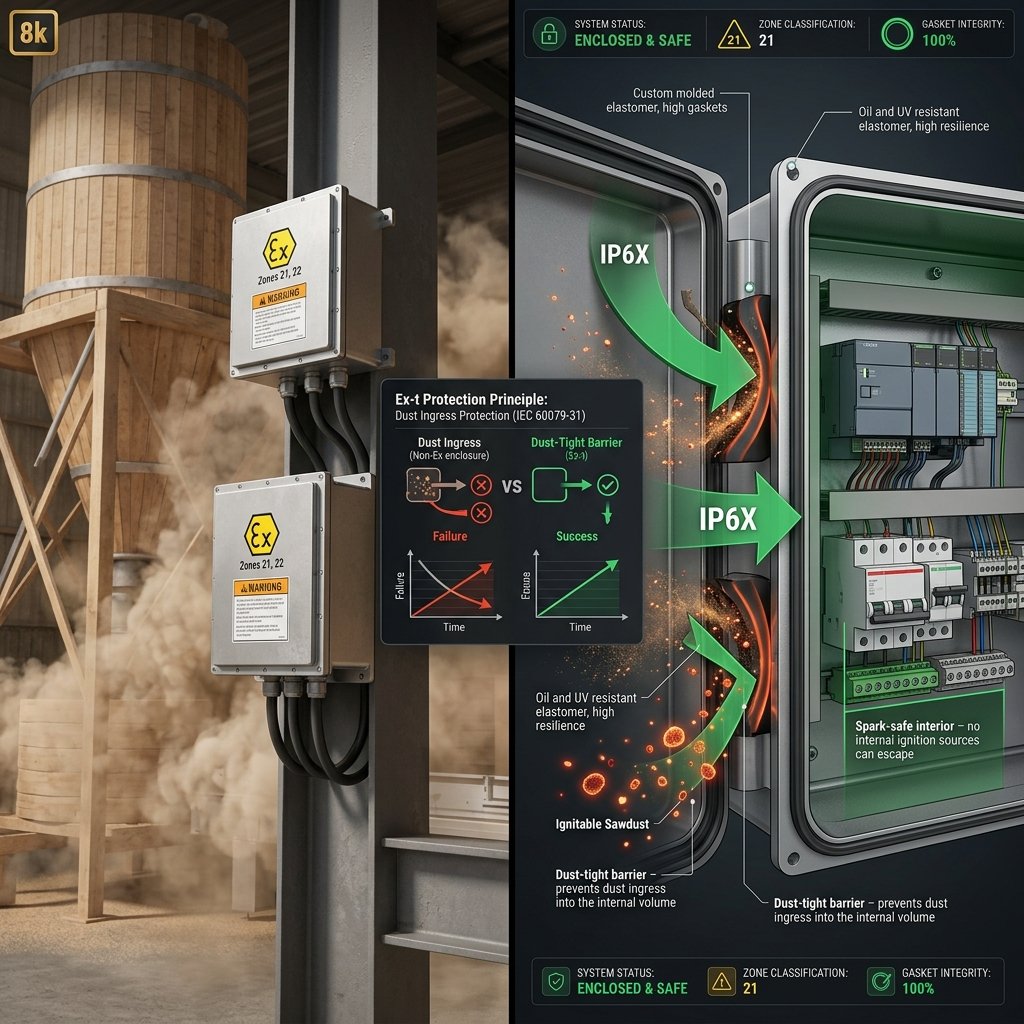
What is IEC 60079-31? Enclosure and Protection for Dusty Environments (Ex t)
Short answer: IEC 60079-31, for flammable dust environments. ‘'Protection with Enclosure (Ex t)'’ It defines the type of protection. By sealing the equipment against dust ingress and limiting the surface temperature, it prevents both the ignition of the dust cloud and the accumulated dust layer. It is the most common protection method in dusty environments.
The most practical and common protection against dust explosions is to completely isolate the equipment from the dust. The logic is simple: if combustible dust cannot enter the enclosure where there is a spark or hot surface, then ignition cannot occur there. Ex t protection does exactly that — it makes the equipment safe with tight sealing and controlled surface temperature.
Two Essential Precautions: Leakage and Temperature
The security of Ex T protection rests on two pillars. Sealing (IP protection): The enclosure is designed with a high degree of protection (typically IP6X — completely dustproof) to prevent dust ingress. Surface temperature limit: The equipment's surface temperature is kept below the ignition temperature of both the dust cloud in the air and the dust layer accumulated on it. This assessment also takes into account the thickness of the layer, as the layer traps heat, thus raising the temperature.
Protection Levels: ta, tb, tc
| Level | Protection (EPL) | Area |
|---|---|---|
| ta | In | Zone 20 |
| tb | Db | Zone 21 |
| tc | DC | Zone 22 |
The more dangerous the area, the higher the level of protection required; 'ta' might be sufficient for Zone 20, and 'tc' for Zone 22.
A Critical Point in the Field: Dust Management Included
The safety of Ex T equipment depends not only on the equipment itself, but also on its surroundings. dust accumulation management This depends on several factors. Gasket aging, cover loosening, or a malfunction at the cable entry point can compromise the seal and render the protection invalid. Similarly, thick dust accumulation on the equipment disrupts the assumed surface temperature. Therefore, Ex t inspection evaluates both equipment integrity and site cleanliness together.
Frequently Asked Questions
In which sectors is Ex t used?
It is common in all combustible dust environments, such as food facilities producing flour, sugar, and starch, as well as woodworking, pharmaceutical, and metal powder production.
Does IP6X protection alone prevent dust explosions?
Sealing is critical but not sufficient; surface temperature limiting and dust layer management must be achieved together.
Secure your dust environment equipment with accredited inspection.
Related service: Explosive Atmosphere (ATEX/Ex-Proof) Inspections.