
What is IEC 60079-17? Periodic Inspection of Electrical Installations in Explosive Atmospheres.
Short answer: IEC 60079-17 specifies that electrical installations and equipment located in explosive atmospheres (gas, vapor or dust) must be inspected after initial installation. remaining safe throughout its operational life It is a standard for periodic inspection and maintenance applied to ensure compliance. Inspections visual, close-up and detailed It divides them into three categories and defines the frequency of performance according to the risk level.
Even a perfectly designed and correctly installed Ex-proof system will deteriorate over time. Corrosion, vibration, overheating, humidity, and the most dangerous of all... unauthorized alterations, It silently destroys the explosion protection capability of the equipment. The facility is just as safe in the fifth year as it was on the first day. proving The only mechanism is periodic inspection. IEC 60079-17 is the international standard that specifies how, by whom, and at what depth this inspection should be carried out.
Why is it critical? Legal and operational necessity.
In Türkiye, Ex-proof inspection is not an option for businesses with explosive environments., legal obligation:
- Occupational Health and Safety Law No. 6331 And Regulation on Protection Against the Hazards of Explosive Atmospheres businesses within the scope Explosion Protection Document (EPD) must prepare.
- For the PKD to remain valid, the equipment must comply with IEC 60079-17. regular check-ups It depends.
- An accident occurring in an uninspected Ex zone would result in both... serious criminal/legal responsibility as well as insurance invalidity She gives birth.
Which sectors and businesses are included?
All production and storage areas where flammable gas, vapor, mist or flammable dust is likely to be present fall under the scope of IEC 60079-17. The main establishments with explosive atmosphere (Ex) zones are:
- Petrochemicals and refineries: Process units, pumping stations, filling yards.
- Fuel and LPG/CNG stations, tank farms: Loading/unloading areas and storage tanks.
- Chemical, paint and solvent plants: Production and mixing areas where solvent vapor is generated.
- Food and feed industry: Silos and grinding lines where combustible dust such as flour, sugar, and starch is generated.
- Pharmaceutical and cosmetic manufacturing: Process areas outside of cleanrooms where alcohol and solvents are used.
- Natural gas and biogas plants, wastewater treatment: Indoor spaces where methane accumulates.
Three Inspection Levels According to IEC 60079-17
The standard defines the inspection in three stages according to its depth:
| Degree | Energy status | What can be done? | Typical usage |
|---|---|---|---|
| Visual | It cannot be cut. | Without tools or ladders, visible defects (broken glass, loose bolts, missing gaskets) can be detected. | Frequent preliminary checks |
| Close | It cannot be cut. | Using a ladder or similar tool, but without opening the equipment, the presence of bolts, fittings, and sealing elements is verified up close. | Periodic inspection |
| Detailed | It is cut | The covers are opened; moisture, corrosion, and deactivated Ex protection systems in the internal piping are tested with instruments. | Initial examination + increased risk |
What should the inspection period be?
IEC 60079-17 does not impose a fixed calendar; the period the risk level of the region, environmental conditions and the condition of the equipment It determines. In general practice, the first detailed inspection is carried out during commissioning, then... not exceeding 3 years Periodic inspections are repeated at intervals; under severe conditions (high corrosion, vibration, frequent intervention), this interval is shortened. The correct period is determined by a risk assessment of an accredited inspection organization.
Who can perform the examination?
Ex-proof inspections must be carried out by a "competent person". For the report to have legal and international validity, the inspection must be completed. Accredited by TURKAK (TS EN ISO/IEC 17020) It is essential that this be carried out by an inspection organization. AES Innovation, Explosive atmosphere (ATEX/Ex-Proof) inspections Within this scope, these audits are carried out by an accredited team of experts.
AES's IEC 60079-17 Inspection Process
AES Innovation conducts Ex-proof periodic inspections in five standardized, traceable steps:
- Preliminary assessment and scope definition: The facility's zone classification (Zone 0/1/2, 20/21/22), equipment inventory, and current Preventive Maintenance and Control (PVC) are reviewed; inspection level and period are determined based on risk.
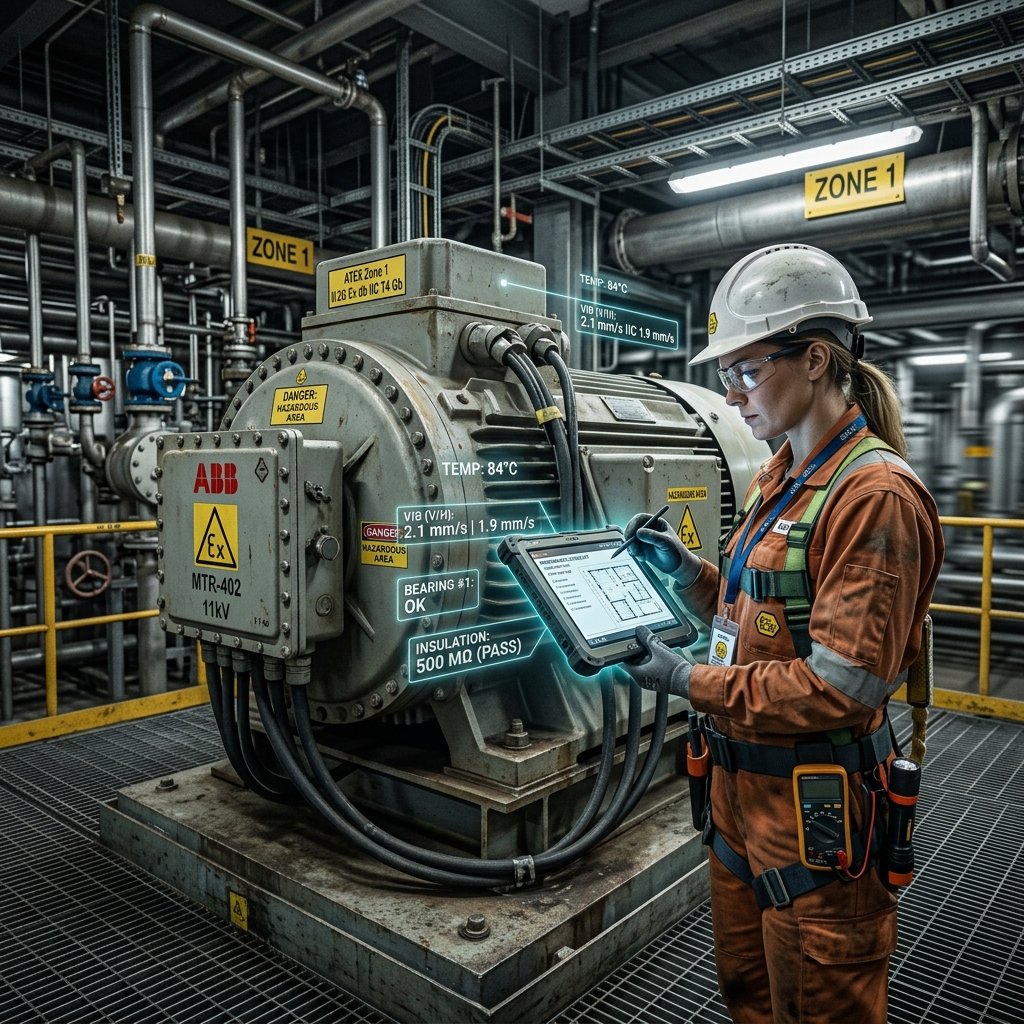
- Field inspection: Visual inspection, close-up and, if necessary, detailed examination; suitability of protection type (Ex d, e, i, t), sealing, cable glands and grounding continuity are checked.
- Measurement and testing: Insulation resistance, grounding continuity, and temperature measurements are performed using calibrated devices.
- Accredited reporting: The findings are reported in accordance with TS EN ISO/IEC 17020, including nonconformity classification and photographic evidence.
- Recommendations for correction and follow-up: A priority action plan is provided for the identified non-conformities; post-improvement verification is performed upon request.
Most Common Nonconformities Encountered in the Field
Typical findings that recur during periodic inspections and directly increase the risk of explosion include:
- Missing or incorrect cable glands: Using the wrong type of fitting will invalidate the enclosure's explosion protection rating.
- Loose/missing bolts: In flameproof (Ex d) enclosures, a missing bolt compromises the integrity of the flame path.
- Gasket and seal failure: Loss of IP protection and Ex integrity due to corrosion and aging.
- Unauthorized alterations: Drilling holes, adding wiring, or changing parts without manufacturer approval will invalidate the certificate.
- Incomplete/inappropriate labeling: The Ex designation indicates that the temperature class and gas group information are unreadable.
Frequently Asked Questions
What is the difference between IEC 60079-17 and IEC 60079-14?
IEC 60079-14 installation design, selection and initial installation regulations; IEC 60079-17 applies after installation. examination and care They regulate. One says "set it up right," the other says "keep it safe.".
What happens if I don't get my regular checkups?
The PKD (Product Protection Law) loses its validity, non-conformities and administrative fines arise during occupational safety and health (OSH) audits, and employer liability and insurance invalidation come into question in the event of a possible accident.
Is visual examination sufficient?
No. Visual inspection only detects superficial defects; internal corrosion, moisture, and deteriorating Ex protection can only be detected. detailed examination It is determined by...
How long does the examination take and when will I receive the report?
The duration depends on the size of the area, the number of pieces of equipment, and the level of inspection. A typical site visit takes 1-3 days; the accredited inspection report is usually delivered within a few business days after the site visit. Expedited reporting can be planned in urgent cases.
Keep your explosion-proof plumbing system safe.
Document the IEC 60079-17 compliance of your explosive atmosphere installation with TÜRKAK accredited, internationally valid reports. Related service: TS EN 60079 Conformity Checks and Ex-Proof Inspection.