

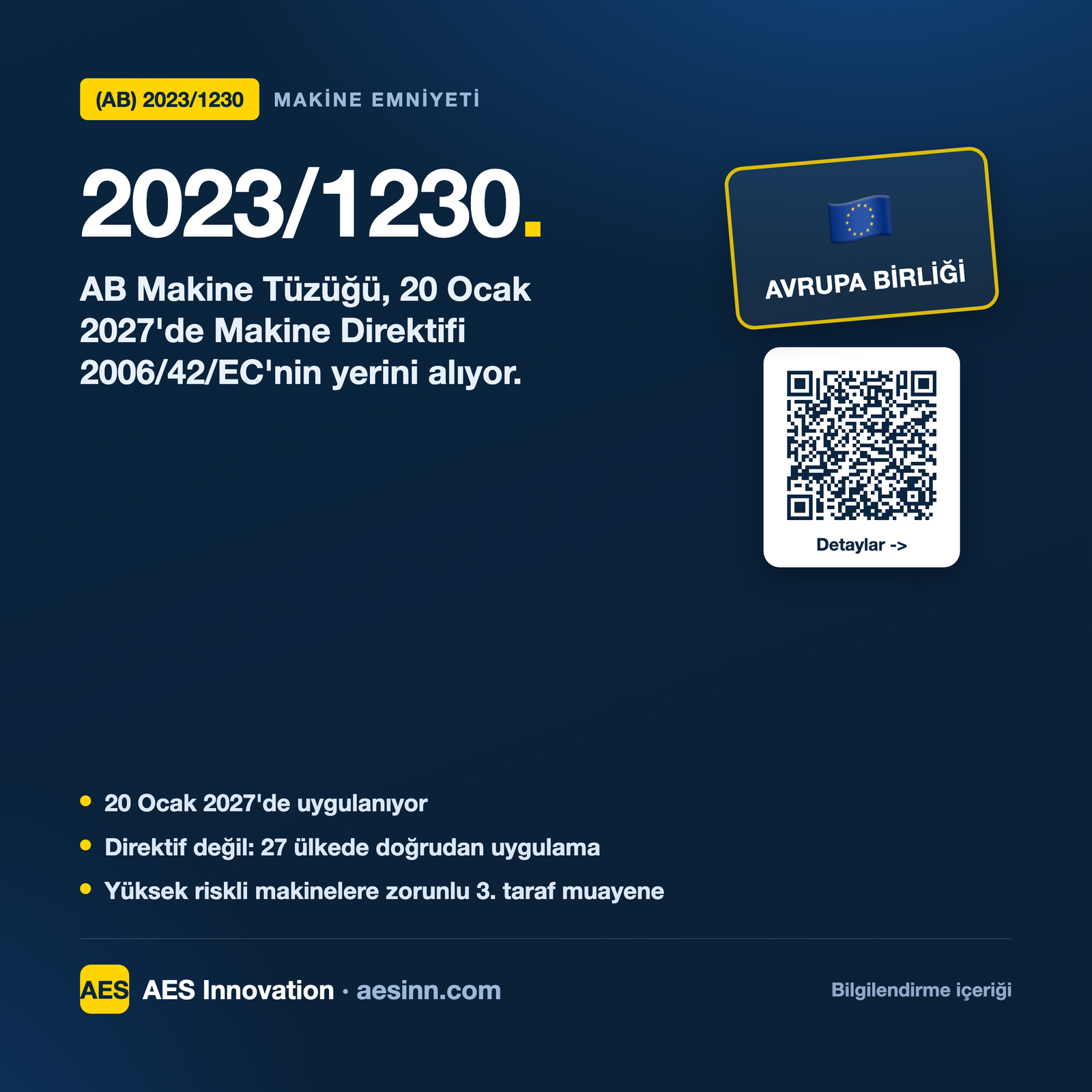
The new Machinery Safety Regulation (2023/1230/EU) has been published: What changes on January 20, 2027?
The Ministry of Industry and Technology has prepared a new regulation based on the EU Machinery Regulation (EU) 2023/1230. Machinery Safety Directive (2023/1230/EU)‘The regulation was published in the Official Gazette dated October 16, 2026, and numbered 33402. The regulation replaces the Machinery Safety Regulation (2006/42/EC) and the regulation on the certification of wire ropes, chains, and hooks (73/361/EC), which have been in effect since 2009. Most of its provisions came into effect on the same day as the regulation in the EU., January 20, 2027‘It comes into effect on [date]. This page summarizes the timeline, transition rules, and key changes for manufacturers and machinery users, based on the text in the Official Gazette.
Effective date
| History | What's happening? |
|---|---|
| October 16, 2026 | The regulation has been published. The purpose, scope and underlying articles, the provisions regarding the appointment of conformity assessment bodies (articles 27-42), committee procedures (article 47) and the transitional provision entered into force on the date of publication. |
| January 20, 2027 | All other provisions enter into force. The Machinery Safety Regulation (2006/42/EC) and the Regulation on wire ropes, chains and hooks (73/361/EC) are repealed; references to them shall be deemed to refer to the new regulation. |
Transition: machines manufactured according to the old regulations
- Products placed on the market before 20 January 2027 in accordance with the Machinery Safety Directive (2006/42/EC) shall not be prohibited from being placed on the market (transitional article 1).
- According to Article 13 of the old regulation, EC type examination certificates and approval decisions remain valid until their expiration date.
- The determining factor is the date the product is placed on the market. Machines placed on the market on or after January 20, 2027, must comply with the new regulation.
Scope
The regulation covers machinery, partially completed machinery and the following related products: interchangeable equipment, safety devices, lifting accessories, lifting chains, ropes and belts, and demountable mechanical transmission devices. The definition of safety device includes physical or digital components, including software.
Key changes
- Compliance assessment for high-risk machinery: For categories in Annex 1 Part A, the manufacturer applies one of the following methods: EU type examination and conformity to type (Modules B + C), full quality assurance (Module H) or unit verification (Module G); self-declaration based on internal production control (Module A) is not applicable in these categories. For categories in Annex 1 Part B, Module A can only be used if harmonized standards or common specifications covering all essential health and safety requirements specific to that category are fully implemented. Module A applies to machines not included in Annex 1.
- Digital usage instructions: Instructions may be provided digitally. The manufacturer shall indicate how to access the instructions on the machine, packaging, or accompanying document; and shall keep the instructions available online in printable and downloadable format for at least 10 years. If the user requests them at the time of purchase, paper instructions shall be provided free of charge within one month; basic safety information shall be provided on paper for machines that may be used by non-professional users. Instructions must be in Turkish.
- Digital EU declaration of conformity: The declaration can be provided with the machine, or it can be presented in the instructions via an internet address or machine-readable code; it must be accessible online for at least 10 years.
- Important change: Any change made after the product has been placed on the market that is not foreseen by the manufacturer, creates a new hazard, or increases an existing risk, and is made by physical or digital means, is considered a “major change” (e.g., adding an enclosure or guard that requires changing an existing safety control system). The natural or legal person making the major change is considered the manufacturer and is subject to the manufacturer's obligations; a non-professional user making the change solely for their own use is not included in this scope (Article 19).
- Importer and distributor: An importer or distributor who places the product on the market under their own name or brand, or who modifies it in a way that affects its conformity, shall be deemed a manufacturer (Article 18).
- Records and documents: The technical file and the EU declaration of conformity shall be kept for at least 10 years. If necessary, the source code or programming logic in the technical file shall be submitted to the Ministry upon a reasoned request (Article 11).
What does this mean for businesses that use machinery?
The regulation governs the placing of machinery on the market; the periodic inspection of machinery used in the enterprise is a separate issue, and Work Equipment Regulations It operates within this scope. However, the most important point that businesses should pay attention to is the significant change rule: Changes such as adding a protective device to an existing machine that requires changing the safety control system, or taking additional measures to ensure its stability or mechanical durability, may make the company making the change the manufacturer for that machine. In this case, the obligations for risk assessment, technical file, conformity assessment, and CE marking pass to the company making the change.
Checklist for preparing for January 20, 2027.
- Classify your product range as Annex 1 Parts A, Part B, and non-Annex 1; plan the notified body schedule in advance for products in Part A.
- If you are using the self-declaration method for Part B products, check that you are fully implementing the relevant harmonized standards.
- Risk assessment (TS EN ISO 12100) and update the technical file according to the new essential health and safety requirements.
- If you will be using digital instructions and a digital compliance declaration, establish the access path, 10 years of online access, and the paper request process.
- Determine the inventory you will release to the market before January 20, 2027.
- Evaluate the potential for significant changes to existing machinery in your factory.
The scope of AES Innovation
AES Innovation's accreditation scope (AB-0631-M) is the periodic inspection of electrical installations. We conduct risk assessments, gap analyses, and technical file studies for CE conformity in machinery together with our solution partners; we are not a notified body and we do not issue CE certificates.
Sources
- Official Gazette, 16.10.2026, No. 33402: Machinery Safety Regulation (2023/1230/EU)
- EUR-Lex: (EU) Machinery Regulation No. 2023/1230
Relating to: Machine CE conformity, risk assessment and technical file. · Conformity assessment method for high-risk machinery. · EU Machinery Regulation 2027 guidance
Frequently Asked Questions
When does the new Machinery Safety Regulation come into effect?
The regulation was published on October 16, 2026. The provisions relating to conformity assessment bodies and the transitional provision enter into force on the date of publication, while all other provisions enter into force on January 20, 2027.
What will happen to my CE marked machines according to 2006/42/EC?
Products placed on the market before January 20, 2027, in accordance with the old regulation will not be prohibited from being placed on the market. EC type examination certificates issued under the old regulation will also remain valid until their expiration date.
Can I only receive the instruction manual in digital format?
Yes, instructions can be provided digitally. However, if the user requests them at the time of purchase, paper instructions should be provided free of charge within one month; basic safety information is provided on paper for machines that may be used by non-professional users.
If I replace a machine in my factory, do I count as a manufacturer?
Yes, if the modification is a significant one that was not foreseen by the manufacturer and creates a new hazard or increases the risk: the natural or legal person making the modification will be subject to the manufacturer's obligations for that machine.