
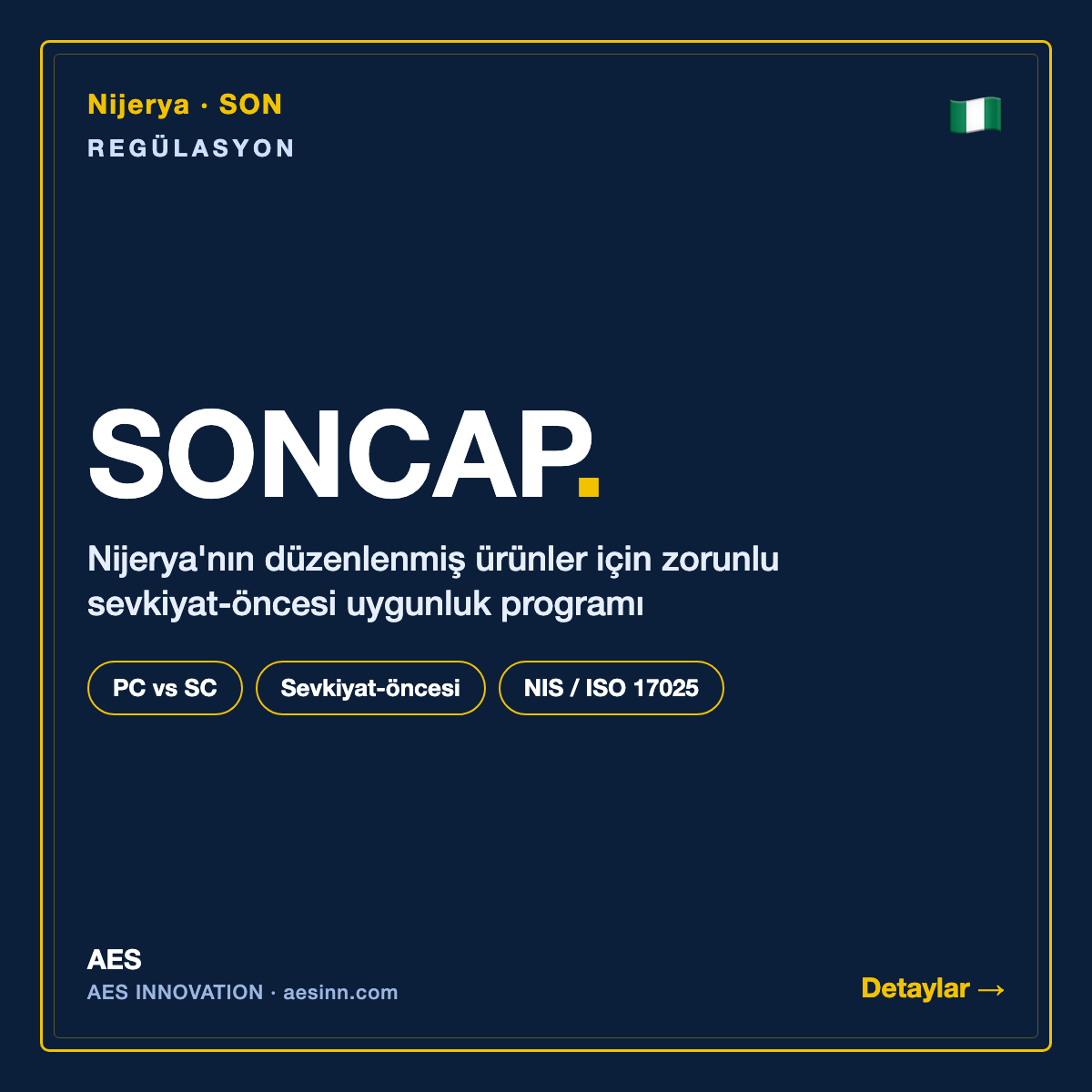
Nigeria SONCAP: Mandatory Conformity Assessment Program for Exports
Introduction: Why should you know about SONCAP?
Nigeria is one of Africa's largest markets and a significant export target for Turkish manufacturers. However, many product groups imported into the country require official proof of conformity to clear customs. This proof is called SONCAP (Standards Organisation of Nigeria Conformity Assessment Programme).
SONCAP is a pre-shipment program established to prevent substandard and unsafe products from entering Nigeria. This article aims to objectively explain what the program is, what documents are required, how the process works, and what it means in practice for Turkish manufacturers exporting to Nigeria.
Note: This content is for informational purposes only. Document fees, scope lists, and procedural details may be updated over time, so it is recommended to verify this information from SON's official sources (son.gov.ng) before proceeding.
What is SONCAP and who is SON?
SON (Standards Organisation of Nigeria) is Nigeria's national standardization organization and the authorized body to run the SONCAP programme. SONCAP, according to SON, is 'a pre-shipment conformity verification process used to verify that products to be imported into Nigeria conform to the relevant Nigerian Industrial Standards (NIS) or their approved equivalents and technical regulations prior to shipment.'‘
The program's basic logic is simple: before the product reaches a Nigerian port, its conformity is verified in the country of origin (i.e., the exporting country). This attempts to prevent unsafe or substandard products from entering the country at their source.
- Executing authority: Standards Organisation of Nigeria (SON).
- Reference: Nigerian Industrial Standards (NIS) or equivalent standards/technical regulations approved by SON.
- Timing: Pre-shipment, meaning before the goods leave the ship.
- Objective: To prevent substandard and unsafe products from entering Nigeria.
Two essential documents: Product Certificate (PC) and SONCAP Certificate (SC)
SONCAP is based on a two-tiered document structure, and it is critical to the process not to confuse the two. The Product Certificate (PC) relates to the product; the SONCAP Certificate (SC) relates to the shipment.
A Product Certificate (PC) documents a product model's conformity to standards and is based on test reports. According to SON, the PC 'represents the conformity of products to quality requirements' and is used in opening CBN Form M, the first step in an import application in Nigeria. The PC is issued to the exporter; the document includes the exporter's information.
The SONCAP Certificate (SC) is a document required separately for each shipment and used during the customs clearance process. According to SONCAP, the SC is used in the PAAR process required for the clearance of goods from Nigerian ports and is issued to the importer; the document includes the importer's information. Without an SC, a valid PC alone is not sufficient for customs clearance.
- Product Certificate (PC): Product model-specific, based on test reports; issued in the name of the exporter; used when opening Form M.
- SONCAP Certificate (SC): Issued for each shipment in the name of the importer; required for customs clearance (PAAR).
- SC cannot be obtained without a valid PC (Product Guarantee) — the product must be verified first, then the shipment documented.
Process: Certification routes (A, B, C) and pre-shipment verification.
SON handles product certification through three different routes, each with different validity and reuse conditions. The choice of route depends on the manufacturer/exporter's status with SON (registered or not) and the frequency of exports.
In summary, the routes are as follows: Route A → Product Certificate 1 (Unregistered), for single shipment use; Route B → Product Certificate 2 (Registered), valid for one year and for multiple use; Route C → Product Certificate 3 (Licensed), valid for one year and for multiple use. For a manufacturer regularly shipping to Nigeria, registered (Route B) or licensed (Route C) routes offer a practical advantage as they provide one year of validity instead of having to document the product from scratch for each shipment.
Conformity assessment itself is not a single process. According to SON, the process may include elements such as pre-shipment physical inspection, sampling, testing and analysis in ISO/IEC 17025 accredited laboratories, auditing of product processes/systems, and documented verification of compliance with regulations. Once conformity is proven, a Certificate of Conformity (CoC) is issued by internationally accredited firms (IAF); SON issues the SONCAP Certificate (SC) after receiving this CoC.
- Route A / PC1 (Unregistered): Single shipment use.
- Route B / PC2 (Registered): Valid for 12 months, multiple uses.
- Route C / PC3 (Licensed): Valid for 12 months, multiple uses.
- Assessment elements: physical examination, sampling, testing in ISO/IEC 17025 laboratories, process/system audit, document verification.
- Certificates of Conformity (CoC) are issued by internationally accredited firms; SCs, on the other hand, are issued by SON based on CoCs.
Products covered and exemptions
SONCAP covers a wide range of regulated products. As a general rule, imported products are covered by SONCAP unless explicitly exempted. Typical covered groups include electrical and electronic products, toys, automotive and spare parts, chemical products, construction/building materials, mechanical devices, furniture, and various consumer goods.
The main exemptions specified by SON are: food products; pharmaceuticals and medical products (excluding equipment); chemicals used as raw materials by bona fide producers; military equipment and contraband/prohibited goods; and used goods, excluding automobiles. Categories such as food and pharmaceuticals may be subject to other regulatory mechanisms in Nigeria.
- Commonly covered categories include: electrical/electronic products, toys, automotive parts, chemicals, building materials, mechanical devices, furniture, and consumer goods.
- Exempt (according to SON): food products; pharmaceuticals/medical products (excluding equipment); chemicals used as raw materials; military equipment and contraband; used goods other than automobiles.
- For precise coverage, please refer to the current regulated/exempt product lists published by SON.
What does this mean for Turkish manufacturers?
For a Turkish manufacturer planning to export to Nigeria, SONCAP is effectively a prerequisite for market entry. The product cannot be cleared through Nigerian customs without a valid Product Certificate and a shipment-specific SONCAP Certificate. Therefore, placing SONCAP at the very beginning of shipment planning—before the production and logistics schedule—prevents delays and port costs.
From a practical standpoint, two points are particularly important. First, the products must be tested in accordance with the relevant NIS or approved equivalent standards; these tests are expected to be carried out in ISO/IEC 17025 accredited laboratories. Second, for manufacturers making regular shipments, registered (Route B) or licensed (Route C) routes, thanks to their one-year validity, reduce the burden of repeating the process each time.
In summary: early planning, testing according to the correct standards, a valid PC, and SC for every shipment — these four elements form the basis for a smooth entry into the Nigerian market. For process details and current requirements, please refer to SON's official resources.
- SONCAP is a prerequisite for customs clearance; place it at the very beginning of your shipment plan.
- Have the products tested according to the relevant NIS/equivalent standards, preferably in an ISO/IEC 17025 accredited laboratory.
- In regular exports, the registered/licensed route (PC2/PC3) reduces the recurring burden with annual validity.
- The PC is issued to the exporter, and the SC to the importer; coordinate the document process with your importer in advance.
Frequently Asked Questions
Is SONCAP a mandatory or optional certification?
It is mandatory. SONCAP is a mandatory pre-shipment compliance program run by SON for regulated goods imported into Nigeria. Regulated goods outside of exempted categories (e.g., food, pharmaceuticals, raw materials, chemicals) cannot be cleared through customs without valid SONCAP documentation.
What is the difference between a Product Certificate (PC) and a SONCAP Certificate (SC)?
PC relates to the product: it documents the conformity of a product model to standards based on test reports, is issued in the name of the exporter, and is used when opening Form M. SC, on the other hand, relates to the shipment: it is issued separately for each consignment, is issued in the name of the importer, and is required for customs clearance (PAAR). An SC cannot be obtained without a valid PC.
What is the difference between routes A, B, and C?
Route A, PC1 (unregistered status), allows for single-shipment use. Route B, PC2 (registered status), is valid for 12 months and allows for multiple uses. Route C, PC3 (licensed status), is also valid for 12 months and allows for multiple uses. Registered/licensed routes offer practical advantages for regular exporters.
Which products are covered by SONCAP, and which are exempt?
General rule: imported products that are not explicitly exempt are covered. Electrical/electronic products, toys, automotive parts, chemicals, building materials, and consumer goods are typically covered. According to the SON (State of Emergency), the main exemptions are food products, pharmaceuticals/medical products (excluding equipment), chemicals used as raw materials, military equipment, contraband goods, and used goods other than automobiles.
Where should the tests be conducted and what standards should they be evaluated against?
Conformity is assessed according to the relevant Nigerian Industrial Standards (NIS) or equivalent standards approved by SON. Testing is expected to be carried out in accredited laboratories meeting ISO/IEC 17025 standards of technical competence. Assessment may include physical inspection, sampling, testing/analysis, and document verification.
This content is for informational purposes only and does not constitute legal opinion or compliance assessment. Current official sources from the relevant country should be consulted for precise obligations.