

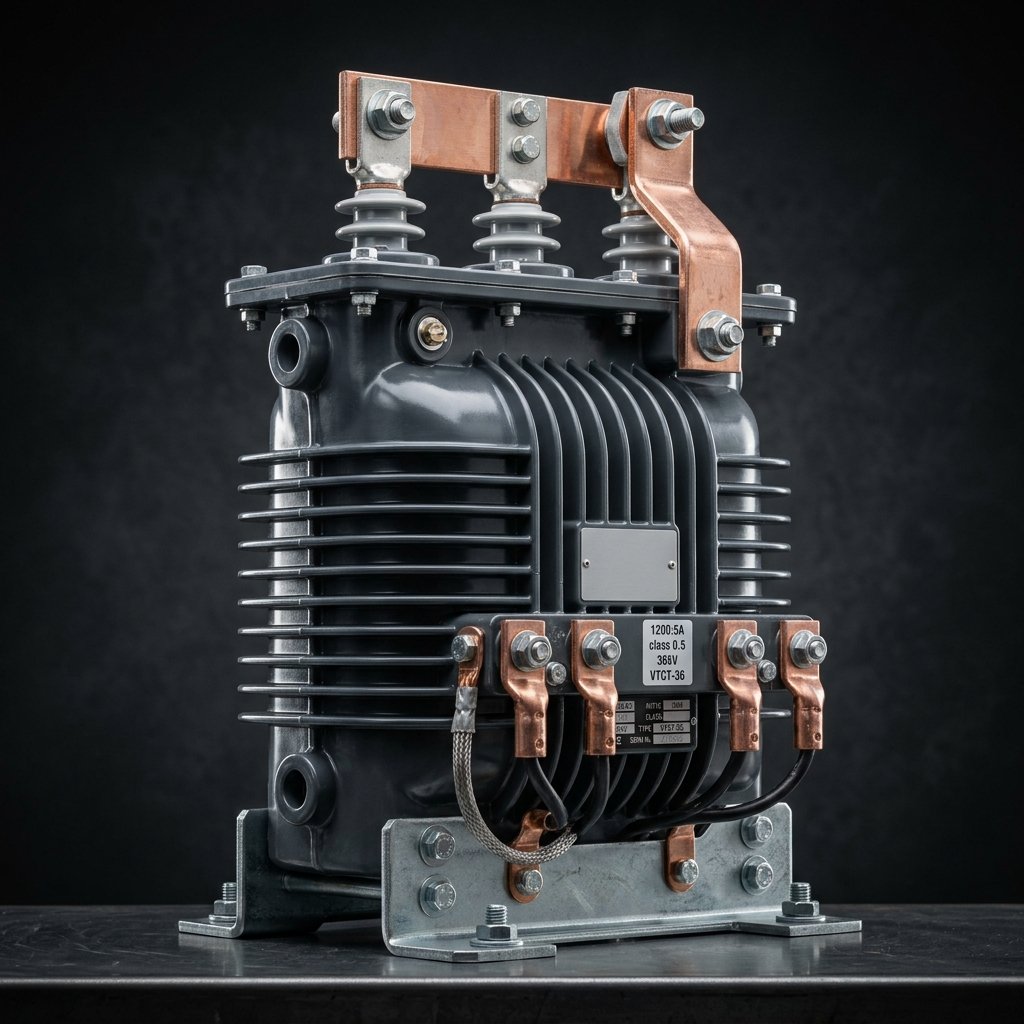
What is IEC 61869? Accuracy of Current and Voltage (Measuring) Transformers.
Short answer: IEC 61869 is the standard for accuracy, performance, and safety of current (CT) and voltage (VT) measuring transformers (replacing the old IEC 60044). These devices reduce power from thousands of amperes to measurable, small levels. accuracy class, This directly determines both your energy bill and the reliability of your protection relays.
If there is a drift in the accuracy of the current transformer at the entrance of your industrial zone or industrial facility, your business will unknowingly suffer losses every month. incorrect energy bill It can pay. If the same transformer is used for protection purposes, and it reaches saturation in a short circuit and cannot power the relay, the facility becomes unprotected.
Two Key Criteria: Accuracy and Satisfaction
| Concept | What does it mean? | Why is it important? |
|---|---|---|
| Accuracy Class | Error limits such as 0.2s / 0.5s | Billing (measurement) accuracy — prevents financial loss. |
| ALF / Saturation curve | Current transformer saturation limit | Correct operation of the relay in a short circuit — protection reliability. |
Billing (Metering) Side
Metering transformers that supply commercial meters. Class 0.2s or 0.5s The error limits should be as narrow as these. Over the years, shifts in magnetic properties or load (burden) mismatches can push the measurement outside the acceptable limit, resulting in under/over billing.
Protection Side
Critical parameters in protective current transformers ALF (Accuracy Limit Factor)‘'Stop. The transformer must not reach saturation under high short-circuit current in the network; it must be able to transfer the current proportionally to the relay. A saturated transformer will "blind" the protection relay, and the fault cannot be cleared.'.
When is verification/verification necessary?
- Commissioning of the new transformer substation (type and routine tests)
- When unexplained discrepancies are observed in invoices
- Before the protection coordination work
- Within the scope of periodic transformer/power system inspection
AES's Measurement Transformer Verification Approach
- Examination of label and application compliance (accuracy class, burden, ALF)
- Ratio, polarity, and accuracy measurements.
- Knee-point saturation curve assessment
- Protection coordination, compliance checks and reporting.
The Hidden Factor Affecting Accuracy: Burden
The accuracy class of a measuring transformer depends not only on the device itself, but also on the transformer's components. load It is connected to the load. Burden is the total impedance (in VA) created by the meter, relay, and cables connected to the secondary circuit of the current/voltage transformer. A transformer provides the accuracy stated on the label within a specific load range; it will operate outside the error limits when operated below or above this range.
The most common fault in the field is exceeding the transformer's rated burden. at very low load The problem is that, for example, a 30 VA current transformer, originally sized for mechanical meters many years ago, is connected to a digital meter that draws only a few VA today. This mismatch leads to measurement errors, especially at low currents, and consequently to billing discrepancies. On the protection side, inadequately sized loads and long secondary cables damage the current transformer. earlier satiety This causes it to reach a short circuit and prevent the relay from being powered. Therefore, the correct assessment should not be made by considering the transformer in isolation, but by considering other factors., along with all the secondary circuits to which it is connected This requires careful consideration. AES's validation work includes burden compliance and cable losses, as well as rate and accuracy measurement.
Frequently Asked Questions
What is the difference between IEC 61869 and IEC 60044?
IEC 61869 is the current and more comprehensive version of the IEC 60044 series; it includes digital (sampled value) measuring transformers and stricter performance criteria.
What is the difference between Class 0.5 and 0.5s?
“The "s" suffix indicates a commercial metering class requiring high accuracy even at low current percentages (e.g., %1 load); it offers a much tighter tolerance than the standard 0.5.
Secure your bill and protection.
Verify the accuracy and protection compliance of your measuring transformers with accredited measurements. Related service: Transformer and Power System Inspections.