
Gateway to Compliance for Exports to the UAE: ECAS and EQM
Why is “compliance” the first step in exporting to the UAE?
The United Arab Emirates is one of the fastest-growing consumer markets in the Gulf region and a significant target for Turkish manufacturers, offering a wide range of products from electrical appliances and building materials to automotive parts and toys. However, there's a crucial fact to know before shipping to this market: the UAE classifies certain product groups as "regulated goods," making their entry and circulation in the market dependent on a compliance checkpoint.
The institution managing this process is the Ministry of Industry and Advanced Technology, or MoIAT. MoIAT has taken over the duties and responsibilities of the standardization and metrology authority previously known as ESMA (Emirates Authority for Standardization and Metrology); therefore, processes referred to as "ESMA registration" in older documents are now carried out under the umbrella of MoIAT. The legal basis rests on Federal Law No. 28 of 2001, which establishes the conformity assessment and quality marking systems.
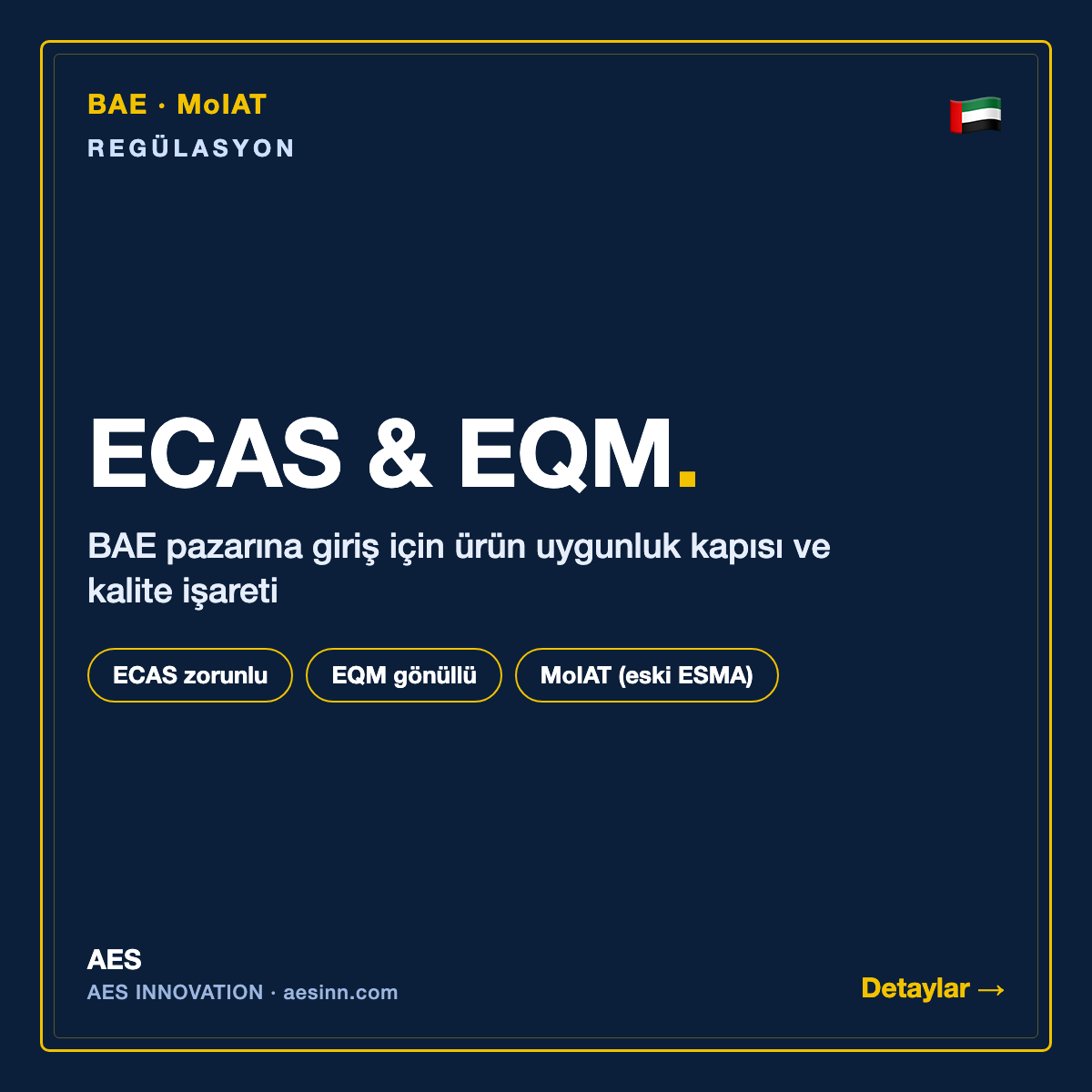
Two main schemes stand out under the MoIAT umbrella: ECAS (mandatory conformity assessment) and EQM (voluntary quality mark). They serve different purposes and it is important not to confuse them. This article aims to explain both objectively, based on official sources.
- Regulatory body: MoIAT (formerly ESMA).
- Legal basis: Federal Law No. 28 of 2001.
- Two main schemes: ECAS (mandatory) and EQM (voluntary quality mark).
- Applications and registration are done through MoIAT's online e-service platform.
What is ECAS? (Compulsory compliance gate)
ECAS, which stands for Emirates Conformity Assessment Scheme, is a mandatory system for assessing and registering the conformity of regulated products to approved standard specifications before they enter the UAE market. In MoIAT's official service description, ECAS is defined as a digital platform that issues "UAE Conformity Certificates" for products subject to technical regulations, and its purpose is to facilitate the entry and circulation of products in the country's markets.
In practice, ECAS is a prerequisite for market entry for a regulated product: without a certificate of conformity, the product cannot be brought into the country and sold on the market. The applicant can be both a manufacturer and an importer/trader. The process proceeds with the submission of test reports, technical files, and proof of conformity required by the relevant technical regulation to MoIAT's e-service platform; registration and SSO (single session) login are required before application.
ECAS conformity certificates are generally valid for one year and are subject to annual renewal; renewal applications should be submitted a reasonable time before the expiration date. Since the validity period and renewal conditions may vary depending on the product group and the relevant technical regulation, it is advisable to confirm the current conditions with the MoIAT platform at the time of application.
- ECAS = Emirates Conformity Assessment Scheme; mandatory for regulated products.
- Objective: To verify the product's conformity to approved standard specifications and to facilitate its market entry/circulation.
- The applicant may be a manufacturer or an importer/trader.
- Applications are made through the MoIAT e-service platform (eservices.moiat.gov.ae) by registering and logging in as a Social Security Signature (SSO).
- Certificates are typically valid for one year and are subject to annual renewal (confirm current requirements with MoIAT).
What is EQM? (Voluntary National Quality Mark)
EQM, which stands for Emirates Quality Mark, is a national quality mark indicating that a product conforms to UAE national or adopted international standard specifications. Unlike ECAS, it is fundamentally voluntary and functions more as an indicator of quality and trust than a "gateway to market." EQM signifies not only that the product conforms to standards but also that it was manufactured in facilities implementing an effective quality management system; therefore, the process typically involves factory audits.
EQM is voluntary for most product groups; however, it may become mandatory for some beverage and food categories (e.g., bottled drinking water, natural mineral water, various soft drinks/fruit juices, and certain dairy products). Examples of areas that can be voluntarily certified with EQM include low-voltage equipment, cosmetics, detergents, energy efficiency (EESL), restriction of hazardous substances (RoHS), and food contact materials (FCM).
The value of EQM for the manufacturer lies in its distinctive quality and reputation in the market: a recognized mark among UAE consumers and buyers, it can provide confidence in shelf and tender competition. The application is made through MoIAT's e-service platform and includes a technical on-site assessment (factory audit).
- EQM = Emirati Quality Mark; is, as a rule, a voluntary national quality mark.
- This indicates that the product conforms to standards as well as being produced based on a quality management system (including factory audits).
- It may be mandatory for certain beverages and dairy products.
- Examples of voluntary coverage include: low-voltage equipment, cosmetics, detergents, EESL, RoHS, and food contact materials.
- Value: market recognition and quality assurance; not a substitute for ECAS for market entry.
Which products are included and how does the process work?
ECAS applies to products subject to technical regulations as defined by regulatory decisions issued by MoIAT. Key regulated categories highlighted in publicly available sources include electrical and electronic equipment (particularly low-voltage equipment), toys and children's products, automotive/vehicle parts, building and construction materials, cosmetics and personal care products, textiles, and certain food products intended for consumption. Whether a product fully falls within the scope and is subject to the required conditions must be verified on a product-by-product basis using MoIAT's "list of technical requirements for regulated products".
The typical process follows these steps: (1) determining whether the product falls within the regulated scope and identifying the relevant technical regulations/standards, (2) having the test done in an accredited laboratory and preparing the technical file, (3) registering with the MoIAT e-service platform and uploading the application and documents, (4) evaluation and issuance of the conformity certificate. In the case of EQM, a factory/facility audit is additionally involved.
It is important to note that process times vary depending on the product and scheme: while MoIAT service descriptions state that the ECAS conformity certification process takes a very short time (approximately one and a half business days), quality marking processes involving factory audits take longer (around six business days). These times only reflect the assessment phase; testing and file preparation also take time.
- Featured areas include: electrical/electronic devices, toys, automotive parts, building materials, cosmetics, textiles, and certain foods.
- The exact scope must be verified on a product-by-product basis against MoIAT's list of technical requirements.
- Steps: scope assessment → testing + technical file → e-service application → evaluation and certification.
- EQM includes additional factory/facility audits.
- The reported processing times reflect only the evaluation phase; testing/file preparation is separate.
What does this mean for Turkish manufacturers?
The practical message for Turkish manufacturers is clear: if you plan to ship a regulated product to the UAE, the first thing to check is whether your product falls under the ECAS (Economic, Customs and Trade Association) system. Because ECAS is practically a mandatory gateway, and market entry is impossible without a certificate of conformity. Making this assessment during the planning stage reduces the risk of delays and returns at customs or during market surveillance from the outset.
EQM, however, should be approached with a different logic. While not mandatory for most products, EQM can be a strategic choice for manufacturers seeking differentiation and quality assurance in the market; however, it should be remembered that it can become mandatory in certain beverage and dairy categories. Therefore, for each manufacturer, answering the questions "Is ECAS mandatory?" followed by "Is EQM mandatory in my product group, and if not, would it provide added value?" will create a sound roadmap.
Finally, two common confusions should be avoided. First, not to confuse ECAS (the UAE national scheme) with the Gulf Cooperation Council’s regional G-Mark (GSO): G-Mark is a regional conformity mark, while ECAS is a national system exclusive to the UAE. Second, not to mistake ESMA and MoIAT for two separate entities: ESMA is a former name for MoIAT. This text is for informational purposes only; for current scope, fees, and procedures, always refer to MoIAT’s official platform.
- First step: determine early whether the product falls under ECAS (ECAS is practically a mandatory gateway).
- Consider EQM strategically: generally voluntary, but mandatory for some beverage/dairy groups.
- Do not confuse ECAS with GCC G-Mark: ECAS is national, G-Mark is regional.
- ESMA = former name of MoIAT; they are not separate organizations.
- Always confirm current scope, fees, and procedures on the official MoIAT platform.
Frequently Asked Questions
What is the main difference between ECAS and EQM?
ECAS is a mandatory conformity assessment and registration scheme that regulated products must pass before entering the UAE market; it is a gateway to the market. EQM, on the other hand, is generally a voluntary national quality mark and indicates that the product conforms to standards and is manufactured based on a quality management system. EQM is not a substitute for ECAS.
Are ESMA and MoIAT the same institution?
Yes, they refer to the same authority. ESMA (Emirates Authority for Standardization and Metrology) was the previous name for the standardization and conformity functions now carried out under the name MoIAT (Ministry of Industry and Advanced Technology). Processes referred to as 'ESMA registration' in older documents are now handled through MoIAT.
How long is an ECAS certificate valid?
In practice, ECAS conformity certificates are generally valid for one year and are subject to annual renewal, and the renewal application is expected to be submitted before the expiration date. Since the validity period may vary depending on the product group, it is recommended to confirm the current requirements with the MoIAT platform at the time of application.
Are ECAS and GCC G-Mark the same thing?
No. ECAS is a national conformity scheme exclusive to the UAE. G-Mark, on the other hand, is a regional conformity mark of the Gulf Cooperation Council (GCC). They have different scopes and authorities; the requirements for a product must be assessed separately.
How and where can I apply?
Both ECAS and EQM applications are submitted through MoIAT's online e-service platform (moiat.gov.ae / eservices.moiat.gov.ae). After registering and logging into the SSO (Supplementary Standards Inspection) system, the application is created, and technical files and test reports are uploaded; for EQM, the factory/facility audit process is also carried out.
This content is for informational purposes only and does not constitute legal opinion or compliance assessment. Current official sources from the relevant country should be consulted for precise obligations.