

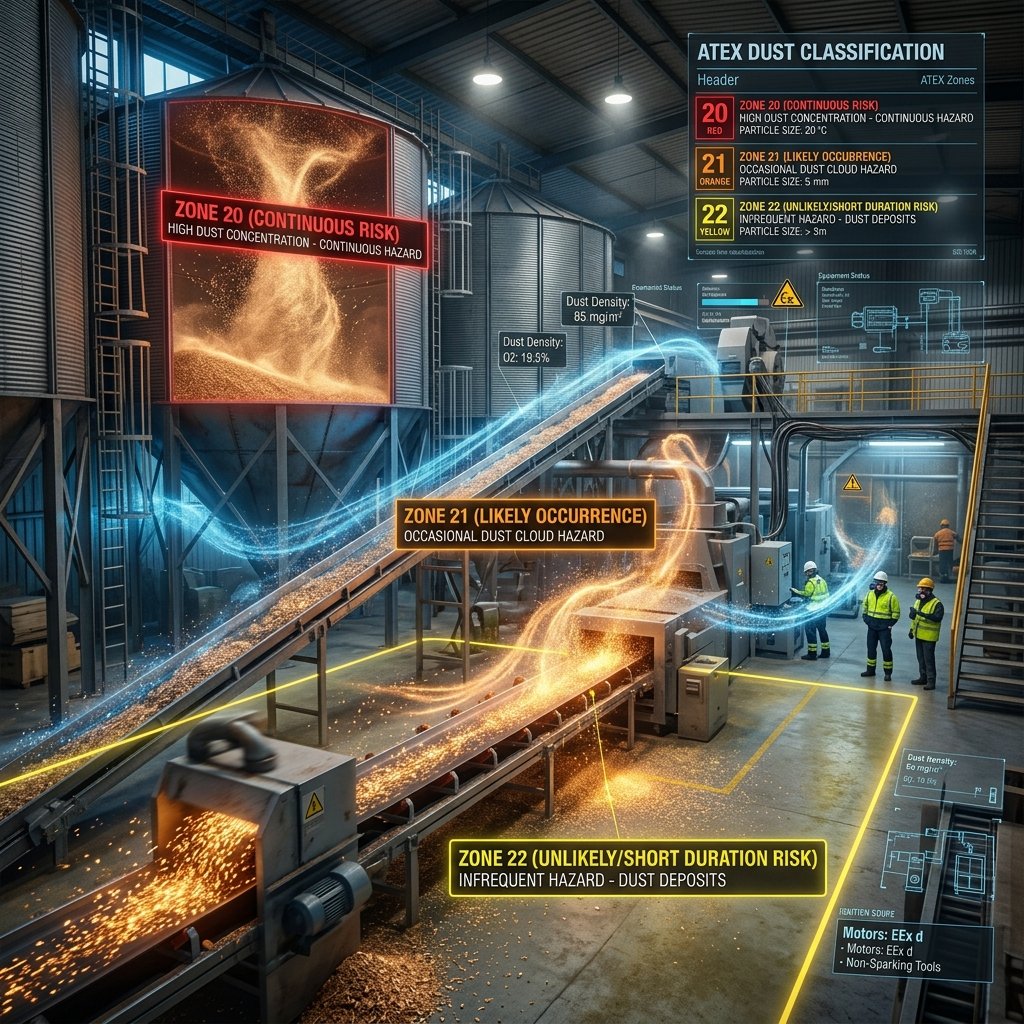
What is IEC 60079-10-2? Area Classification in Flammable Dust Environments.
Short answer: IEC 60079-10-2, flammable dust It defines area classification in their environment. It divides areas into Zone 20, Zone 21 and Zone 22 according to the frequency of dust being present in clouds or sheets. It is the equivalent of gas classification (10-1) in the dust world and manages a frequently overlooked but deadly risk.
When explosions are mentioned, gas usually comes to mind, but combustible dust is at least as dangerous. Flour, sugar, starch, wood, coal, and metal dusts, when suspended in the air at the right concentrations, lead to violent explosions; moreover, accumulated dust layers can trigger secondary explosions, destroying the entire plant. IEC 60079-10-2 systematically maps this risk.
Three Dust Zones
| Area | Dust cloud situation | Example |
|---|---|---|
| Zone 20 | Continuous or prolonged dust cloud | Inside the silo/filter |
| Zone 21 | It occurs from time to time during normal operation. | Filling nozzles, sieving |
| Zone 22 | It doesn't normally occur, and if it does, it's short-lived. | Equipment environment |
The Difference Between Dust and Gas: The Risk of Layering
The most critical factor distinguishing dust classification from gas is, accumulated dust layers. Dust accumulated on surfaces is just as dangerous as dust clouds in the air: it insulates equipment, leading to overheating (hence the temperature rating is determined by layer thickness), and the air currents created by an initial explosion can lift these layers, creating a much larger hazard. secondary explosion It feeds. Therefore, in dusty environments, cleaning and dust management are an integral part of classification.
Correct Classification and Equipment Selection
Dust zones also correspond to the equipment protection level (EPL): Da for Zone 20, at least Db for Zone 21, and at least Dc for Zone 22. The most common protection method in dusty environments is sealing the equipment against dust ingress. enclosure protection (Ex t — IEC 60079-31)‘AES (Automated External Demand) monitors equipment and dust management compliance together with dust area classification.
Frequently Asked Questions
Which sectors are at risk of dust explosions?
All facilities that produce combustible dust, especially those in the food and feed (flour, sugar, starch), wood, pharmaceutical, chemical, and metal processing industries, are at risk.
Why does the dust layer affect the temperature rating?
Accumulated dust traps heat from the equipment, raising the surface temperature; therefore, the maximum allowable surface temperature is determined by considering the layer thickness.
Map and Manage Your Dust Explosion Risk
Related service: Explosive Atmosphere (ATEX/Ex-Proof) Inspections.