


Grounding System Measurements | General Information
Electrical installations have become an integral part of our lives. Today, it's safe to say that living without electricity is not easy. While electricity makes our work easier in countless ways, poor insulation can pose a danger to people and other living things.
This danger is called "electric shock". Insulation problems can also lead to fires.
For humans and other living beings to experience an electric shock, two separate points on their bodies must have different electrical potentials, causing a current to flow through them.
A person may touch live parts of a system either directly or indirectly. Measures to protect against direct contact can be summarized as structural and mechanical precautions, as well as insulation.
Ground; It is the process of connecting the inactive (not under voltage during normal operation) metal parts of electrical equipment (generators, transformers, motors, circuit breakers, disconnectors, poles, lighting fixtures, refrigerators, washing machines, etc.) to the ground via a conductor.
Connection to the ground is made through various types of grounding electrodes.
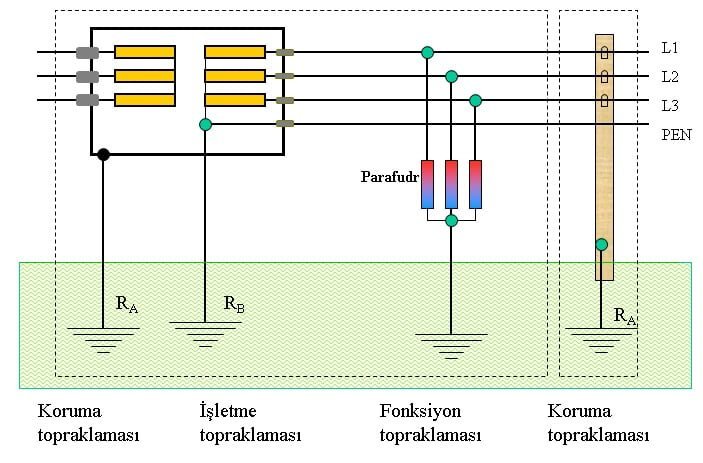
Grounding is done for three main purposes.
1. Protective earthing
Grounding of inactive metal parts of equipment (parts not normally under voltage) is a way to protect people from dangerous touch voltages.
2. Operational grounding
Grounding of the operating current circuit for the normal operation of the facility. (This refers to grounding of the active parts. Parts that may be under voltage under normal conditions.)
3. Functional grounding
Grounding is the process of ensuring that a communication facility or operational component performs its intended function.
Examples of lightning protection include grounding for railway systems and operational grounding for communication facilities.