

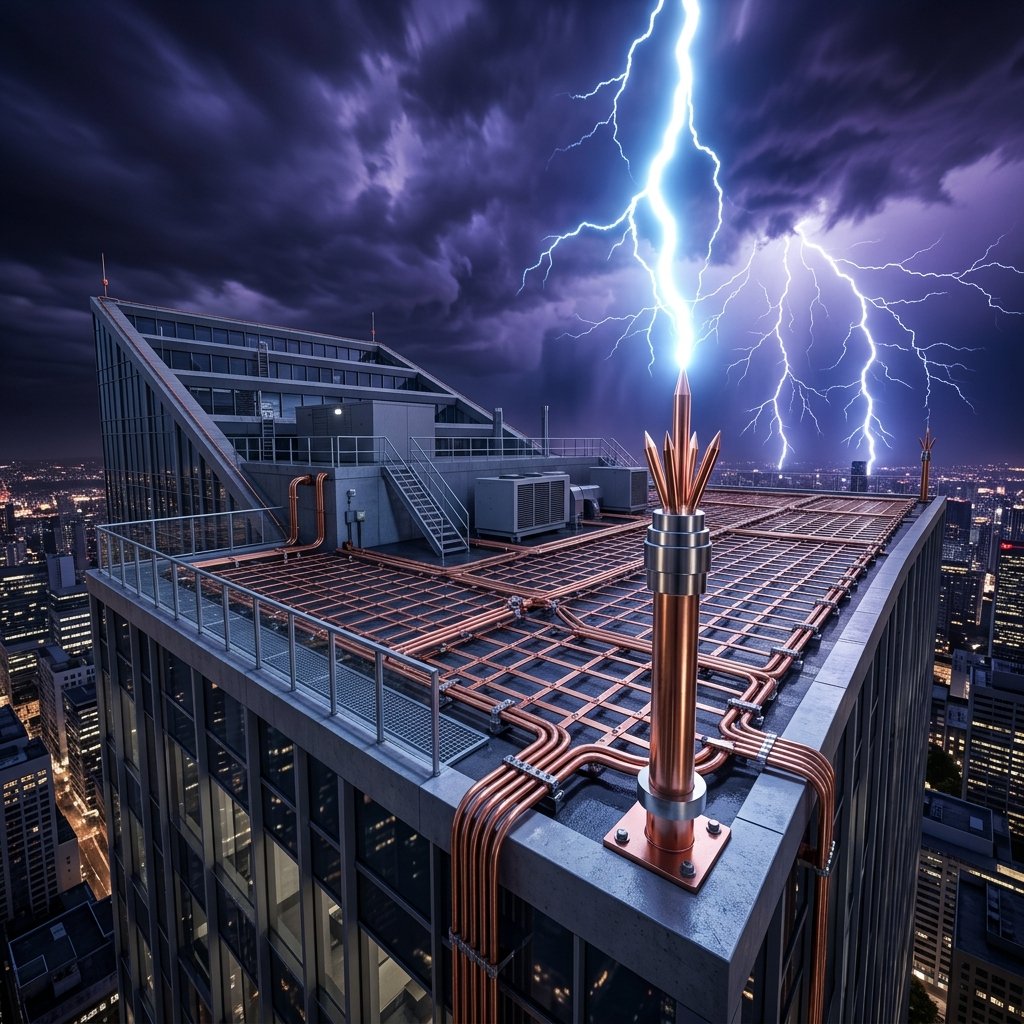
What is IEC 62305? Lightning Protection System Design and Risk Analysis.
Short answer: IEC 62305 is the international lightning protection standard applied to protect structures against direct lightning strikes and indirect overvoltages. It consists of four sections: risk analysis, external lightning protection (catch-down-grounding), internal lightning protection (SPD), and electronic system protection, and the protection measures... computationally based It makes it necessary to do so.
Many businesses simply erect a random lightning rod on their buildings, believing they are safe. However, an installation not calculated according to IEC 62305 will cause lightning to travel across the roof instead of safely grounding it. by throwing a back It can directly damage your production lines or cause a fire. This standard is the modern, engineering-based equivalent of the ancient "lightning rod" concept.
What does the IEC 62305 Series cover?
| Part | Subject | What does he do? |
|---|---|---|
| Part 1 | General principles | Lightning current parameters and protection levels (LPL I–IV) |
| Part 2 | Risk management | Calculating R1–R4 risks and determining the need for protection. |
| Part 3 | Physical injury (LPS) | External lightning protection: lightning arresters, down conductors, grounding. |
| Part 4 | Electrical/electronics (LEMP) | Internal lightning protection: SPD (surge arrester) coordination and shielding. |
Risk Analysis (Part 2): R1–R4
Protection design begins with calculation, not estimation. Four risks are calculated taking into account the lightning intensity (keraunik level) at the building's geographical location, the presence of flammable/explosive materials, the number of people inside, and the need for service continuity:
- R1 – Risk of loss of life (most critical, lowest acceptable limit)
- R2 – Loss of public service (energy, communication)
- R3 – Loss of cultural heritage
- R4 – Economic depreciation (production, equipment)
If the calculated risk exceeds the acceptable limit, then necessary Level of Protection (LPL I–IV) This is determined and the system is designed accordingly.
External and Internal Lightning Protection
External lightning protection (LPS): The discharge current obtained through the Faraday cage, tension wire, or catch terminals is safely transferred to ground via step-down conductors. The components must be tested for resistance to electromechanical forces.
Internal lightning protection (SPD): The building receives coordinated surges of overvoltage induced by lightning. surge arrester (SPD) It is suppressed in stages (Type 1/2/3); otherwise, the control panel, server, and automation cards will burn out.
Separation Distance
The down conductor that runs from the roof to the ground connects to metal pipes or electrical cables in the building. not throwing a spark The insulation distance (S) that must be left between them is calculated using a formula. If this distance is not provided, the system becomes a source of danger instead of protection.
In which structures is it critical?
- Fuel/LPG facilities, factories containing chemical and explosive atmospheres.
- Hospitals and data centers (uninterruption is critical)
- Shopping malls, plazas and high-rise buildings (crowds of people)
- Facilities and power plants located at high altitudes.
AES Lightning Protection Service
- Determining the level of protection through risk analysis (IEC 62305-2)
- Verification of external/internal lightning protection and SPD coordination design.
- Grounding resistance and continuity measurements
- TURKAK accredited periodic inspection and reporting.
- Prioritized improvement plan for non-conformities.
Three Types of Damage Lightning Causes to a Structure
To properly design lightning protection, it's essential to first understand how damage occurs. A lightning discharge damages a structure in three different ways. Firstly, there is the thermal effect: Tens of thousands of amperes of current will melt metal and ignite wood and insulation materials if the conductor cross-section in the path of downflow is insufficient. The second is the mechanical effect: The electrodynamic forces generated by the current break loose connections and dislodge conductors; therefore, it is essential that the components pass electromechanical strength tests.
The third and most insidious effect is induction (LEMP). Even if lightning doesn't directly strike the building, but happens nearby, the rapidly changing magnetic field induces high-voltage pulses in the building's internal cables and data lines. These pulses destroy servers, PLCs, and communication cards within milliseconds. This is why simply installing a lightning rod on the roof (external lightning protection) is not enough; Internal protection with coordinated SPD (surge arrester) stages This should also be done. In addition, the discharge spreads into the soil, creating a barrier in the ground. step and touch voltages, This is a separate hazard for people around the building and is taken into account in grounding design. IEC 62305 is a much more comprehensive engineering discipline than simply 'installing lightning rods' because it addresses all three of these effects.
Frequently Asked Questions
How often should lightning protection systems be inspected?
According to legislation, periodic inspection of lightning protection (lightning rod) systems is required. at least once a year It should be done; it is recommended even more frequently in risky environments.
Is the active lightning rod compliant with IEC 62305?
IEC 62305 does not cover early current (ESE) active lightning arresters; the standard is based on passive (Franklin/cage) systems. The use of active lightning arresters is subject to separate national regulations and does not replace risk analysis alone.
Do I need to install an SPD (surge arrester)?
Yes, if a risk analysis is required. Especially in facilities with high electronic load, external lightning protection alone is not sufficient; without coordinated lightning protection, the risk of internal damage persists.
Protect your facility against lightning with lightning engineering.
Determine your building's lightning risk with IEC 62305 risk analysis, and establish protection through calculation, not guesswork. Related service: Lightning Protection Services.