

Lightning Protection System Measurements
Lightning Protection System Measurements | General Information
There are no devices or methods capable of altering natural weather conditions to the extent that they can prevent lightning discharges. Lightning striking structures, nearby structures, or service installations connected to structures poses a danger to people, structures, their occupants, and service installations. Lightning is one of the most exciting and interesting phenomena. On average, 1800 lightning strikes occur per minute in different geographical locations around the world, with varying frequencies and amplitudes. For example, lightning does not occur at the poles of the Earth, while it occurs many days of the year in the equatorial region. .
The performance of lightning protection systems commonly used today has been investigated through theoretical and experimental studies. However, some of these studies have been heavily influenced by commercial concerns.
Lightning discharges are explained by channel theory in large electrode gaps. For the initiation of conductive channels and surface discharges that can lead to lightning discharges, it is sufficient for the local electric field strength to exceed approximately 5 kV/cm.
In a cloud, when the electric field strength becomes sufficiently large due to the accumulation of charge, discharges (lightning) can occur between clouds, within clouds, or between clouds and the ground. In tall structures such as towers, when the electric field strength reaches a certain value, upward-moving lightning can occur.
Yıldırımın kutbiyeti, dalga şekli ve akımının tepe değeri, yıldırımın karakteristik büyüklükleridir. Yıldırım boşalmalarının kutbiyeti negatif veya pozitif olabilir. Oluşan yıldırımların %70 -%90’ı negatif kutbiyetlidir. İnsanları, binaları, tesisleri ve donanımları yıldırımın etkilerine karsı korumak amacıyla, yıldırım boşalmalarının kontrolü ve yönlendirilmesi, elektrik mühendislerinin yıllardır devam eden bir uğraşı alanı olup; konuyla ilgili araştırmalar, yıldırım boşalmasının kesin olarak tanımlanamayan bazı belirsiz yanları nedeniyle hala devam etmektedir.
The aim of lightning protection is to eliminate or minimize the direct and/or indirect effects of lightning. While in the past the purpose of lightning protection was limited to ensuring life safety against lightning and preventing fires, advancements in technology and living standards have brought the concept and scope of protection to a much more advanced level.
However, it is known that providing absolute protection against the direct or indirect effects of lightning is generally very difficult. For example, when lightning strikes a lightning protection system or a point in the structure, depending on the grounding resistance of the system and the value of the current, a potential tent can be formed in the ground transition zone and throughout the entire structure, with peak voltages reaching the order of hundreds of kilovolts.
RELEVANT STANDARDS AND REGULATIONS
There is no regulation regarding lightning protection in our country. A draft regulation on lightning protection, prepared through intensive and comprehensive studies, remains at the draft level because it was not published in the Official Gazette by the relevant ministry.
On the other hand, regarding lightning protection systems, although current standards have been published, the fact that their implementation is not mandatory and there is no regulation on the subject leads to very different practices.
For example, even though the Turkish Standards Institution (TSE) abolished the old standard and its annexes on the subject and published the IEC (International Electrotechnical Commission) standard series, the relevant ministry still considers the old standard as the mandatory standard.
This standard, mandated by the Ministry, also includes definitions of radioactive detection points and installation types (Article 2.1.5.2.7). On the other hand, the TS 622/1990-T1/March 2005 amendment standard, based on the Turkish Atomic Energy Authority's letter dated January 4, 2000, number 104, stated that the import of Am-241 based radioactive detection points was not permitted from March 31, 2000, on the grounds that they did not provide a clear practical benefit and that radioactivity levels reached high values, especially in large cities; however, it also stated that installed radioactive detection points of this type could be used until the end of their lifespan, and, based on the Turkish Atomic Energy Authority's Circular 2001/001, it prohibited the use of Ra-226 based radioactive detection points and mandated the dismantling of existing installed detection points of this type.
However, as is known and clearly stated on the TSE's website, Turkish Standards prepared by the Turkish Standards Institute are voluntary. If the relevant Ministry decides that a standard is important in terms of life and property safety, environmental protection, etc., and that the parties should comply with this standard, it can make the standard mandatory by publishing it in the Official Gazette with a communiqué. Control and supervision in the implementation of these standards are within the authority and responsibility of the relevant Ministry. When a standard that has been made mandatory is revised or another standard is prepared in its place, the Turkish Standards Institute notifies the relevant Ministry. The making of the standard(s) mandatory and the cancellation of the mandatory status of the old ones are entirely within the authority and responsibility of the Ministry.
Indeed, the Turkish Standards Institution (TSE) website (https://www.tse.org.tr/) states that the TS 622/December 1990, TS 622/1990 – T1/March 2005, and TS IEC 61024-1-1/2002 standards have been cancelled by TSE, but the TS 622/December 1990 standard remains mandatory under the relevant Ministry (access date: 29.09.2011). The first part of the series of standards published and put into effect by TSE (Turkish Standards Institution) outlines the general principles to be followed in lightning protection of buildings, their installations, their contents and people, and service installations connected to buildings; the second part concerns the assessment of risks to buildings or service installations caused by lightning strikes to the ground; the third part covers the rules regarding the protection of a building against physical damage by a lightning protection system and the prevention of harm to living beings due to touch and step voltages generated near the protection system; and the fourth part includes information on the design, installation, inspection, maintenance, and testing of a protection system that provides the possibility of reducing the risk of permanent failures caused by lightning electromagnetic pulses for electrical and electronic systems in a building. The fifth part of the series, not yet published by TSE, defines the measures that should be taken to reduce damage and failures to service installations (primarily electrical and telecommunication lines) connected to a building.
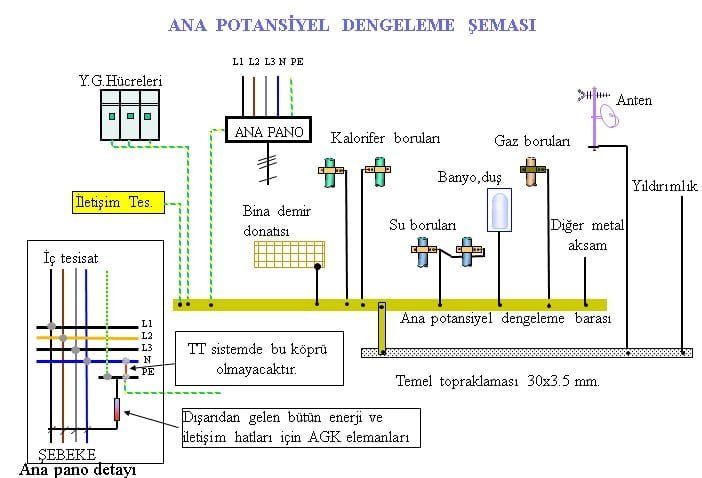
This standard series, in summary, describes the classic protection system consisting of Franklin rods and a Faraday cage, emphasizing the necessity of creating equipotential bands and using protection schemes against current/voltage surges.